
Warwick Ward (Machinery) Ltd, a Barnsley-based dealer of construction plant, earthmoving and waste-recycling equipment, entered administration on 3 December 2025. Interpath Advisory’s James Lumb and James Clark were appointed joint administrators after attempts to refinance or sell the business as a going concern failed. Around 89 jobs were reported lost, with nearly all staff made redundant (Construction Enquirer; The Construction Index).
Although it’s often described as a “construction firm collapse”, Warwick Ward wasn’t a builder. It was a long-established machinery dealer serving the construction, quarrying and recycling industries. Its failure is notable because the company had been sold to an Employee Ownership Trust (EOT) in June 2023, and administrators said debt taken on during that transition was a contributing factor. Below is what happened, why, what it means for customers and suppliers, and what the wider industry can learn.
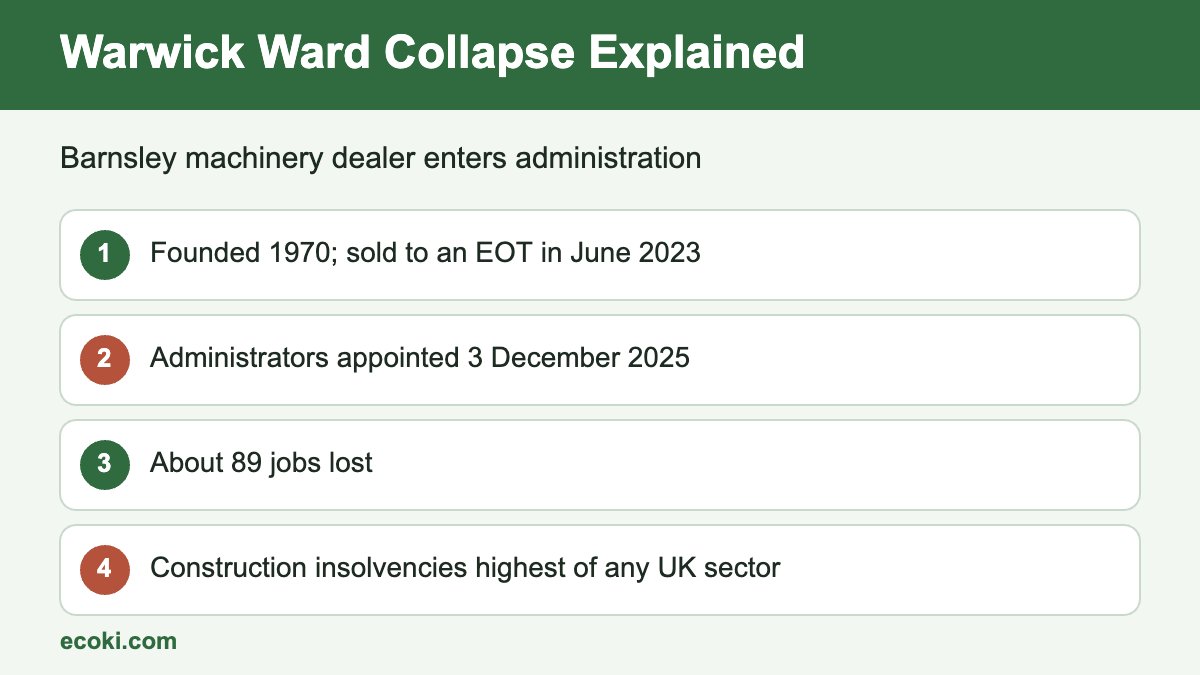
Warwick Ward Collapse: Key Facts
| Company | Warwick Ward (Machinery) Ltd |
|---|---|
| Business | Dealer of earthmoving, recycling and materials-handling machinery, plus parts and servicing |
| Founded | 1970 |
| Headquarters | Barnsley, South Yorkshire |
| Depots | Barnsley, Bromsgrove and Harlow (as reported) |
| Ownership change | Sold by the Ward family to an Employee Ownership Trust, June 2023 |
| Administration date | 3 December 2025 |
| Administrators | James Lumb and James Clark, Interpath Advisory |
| Jobs lost | About 89 reported |
| Last reported family-era results | £51.2m sales, £679,000 pre-tax profit |
The administration notice was published in The Gazette, the UK’s official public record.
Who Was Warwick Ward?
Founded in 1970, Warwick Ward grew into one of the better-known independent machinery dealers in the UK. It sold and serviced equipment used on construction sites, in quarries and at waste and recycling plants: excavators, loading shovels, crushers, screeners and shredders. Customers ranged from small plant-hire firms to large recycling operators.
A dealer like this sits in the middle of a long supply chain. It buys machines from manufacturers, often holds expensive stock, offers finance arrangements, sells to contractors, and then earns ongoing income from parts and servicing. That model can be profitable, but it ties up a lot of working capital.
Timeline: From Family Firm to Administration
- 1970: Warwick Ward is founded.
- Decades of growth: The firm builds a reputation as a major stockist of earthmoving and recycling machinery, with several depots across England.
- June 2023: The Ward family sells the business to an Employee Ownership Trust.
- 2024–2025: Trading conditions in construction and plant markets remain tough, with high interest rates and weak demand for new machines in parts of the market.
- Late 2025: Efforts to refinance or find a buyer fail.
- 3 December 2025: Interpath’s James Lumb and James Clark are appointed joint administrators.
- December 2025: Most staff are made redundant; administrators begin selling assets.
Why Did Warwick Ward Collapse?
Administrators cited two broad causes:
1. Wider economic headwinds
The UK construction sector has faced a difficult stretch: higher borrowing costs, slower housebuilding and commercial activity in some segments, and cautious spending on new equipment. When contractors delay buying machines, dealers holding stock feel the pressure first.
2. Debt from the employee-ownership transition
According to reports quoting administrator James Lumb, the debt taken on as part of the move to employee ownership contributed to the company’s difficulties (Construction Enquirer). In many EOT deals, the trust buys the founders’ shares using deferred payments funded from the company’s future profits, sometimes supplemented by bank borrowing. If profits fall, those obligations can squeeze cash flow just when the business needs it most.
Employee Ownership Trusts: What Went Wrong?
Employee ownership has grown quickly in the UK since EOTs were introduced in 2014 with tax incentives: founders can sell a controlling stake to a trust without paying capital gains tax, and employees can receive tax-free bonuses up to a limit. Many EOT companies thrive. But Warwick Ward’s case highlights risks that owners and employees should understand.
| EOT feature | Benefit | Risk if trading weakens |
|---|---|---|
| Deferred consideration to founders | No need to find a buyer with cash upfront | Ongoing payments drain cash from the business |
| Bank or vendor debt | Speeds up payment to founders | Interest and repayments add fixed costs |
| Valuation set at sale | Founders get a fair price in good times | A high valuation becomes a burden if profits fall |
| Employee engagement | Can boost loyalty and productivity | Employees may lose jobs and the business they “own” |
Lessons for EOT deals
- Stress-test the deal against a downturn, not just the base case.
- Keep deferred payments flexible, with the ability to pause them if profits fall.
- Avoid stacking external debt on top of founder payouts in cyclical industries.
- Maintain strong cash buffers for businesses that hold expensive stock.
- Get independent advice on valuation, rather than relying only on the sellers’ advisers.
The Bigger Picture: UK Construction Insolvencies
Warwick Ward’s collapse came amid persistently high insolvency levels in construction. According to Insolvency Service figures for England and Wales, construction recorded 3,805 company insolvencies in the 12 months to June 2026, more than any other industry. In the 12 months to February 2026, construction made up around 17% of insolvencies where an industry was recorded, ahead of wholesale and retail, and accommodation and food services (The Gazette / Insolvency Service; The Gazette, February 2026).
Within construction, firms doing specialised construction activities, such as electrical, plumbing and finishing trades, consistently account for the largest share.
Why construction businesses are vulnerable
- Thin margins: fixed-price contracts leave little room when costs rise.
- Late payment: long payment chains and retentions starve subcontractors of cash.
- Cyclical demand: housebuilding and commercial projects swing with interest rates.
- High fixed costs: machinery, depots and skilled staff are expensive to carry through slow periods.
- Knock-on failures: when a contractor fails, unpaid suppliers can fail too.
What Administration Means
Administration is a UK insolvency procedure in which licensed insolvency practitioners take control of a company. Their priorities are, in order, to:
- Rescue the company as a going concern, if possible.
- Achieve a better result for creditors than an immediate liquidation would.
- Realise assets to pay secured or preferential creditors.
In Warwick Ward’s case, attempts to sell the business as a going concern were reported to have failed, so the focus moved to selling assets such as machinery stock, parts and equipment.
What It Means for Customers, Suppliers and Staff
Customers with machines under warranty or service plans
- Contact the manufacturer of your machine: brand warranties are often honoured through another authorised dealer.
- Keep copies of invoices, warranty documents and service records.
- Ask the administrators about any prepaid services or deposits; you may need to file a claim as an unsecured creditor.
Suppliers and creditors
- Submit a proof of debt to the administrators.
- Check retention-of-title clauses in your terms; goods not yet paid for may be recoverable if identifiable.
- Expect unsecured creditors to recover only a fraction of what they’re owed, if anything.
Employees
- Redundant staff can claim certain statutory amounts, such as redundancy pay, notice pay, holiday pay and some arrears of wages, from the government’s Redundancy Payments Service, within statutory limits.
- Administrators provide the details needed to make claims.
Plant and Machinery Dealers: A Tough Market
Dealers like Warwick Ward face pressures specific to their part of the industry:
- Stock financing costs rose sharply when interest rates went up.
- Manufacturer relationships can shift, with brands consolidating dealer networks.
- Used-machine price swings affect trade-in values and stock valuations.
- Customers delaying purchases or renting instead of buying during uncertain times.
At the same time, the shift toward electric and hybrid plant and stricter emissions rules is changing what customers buy. Recycling and waste-processing equipment, one of Warwick Ward’s specialities, is tied closely to the circular economy, an area that’s expected to keep growing as construction tries to cut waste. If you’re interested in lower-impact building materials, see our guides to eco-friendly driveways and eco-friendly roofing.
What Happens to Machinery Stock in an Administration?
For a machinery dealer, stock is usually the most valuable asset. In administration it typically goes through several channels:
- Return to manufacturers or finance houses where machines were supplied on stocking finance or retention-of-title terms.
- Sale to other dealers who can absorb new machines into their networks.
- Auctions of used equipment, parts and workshop tools, often run by specialist industrial auctioneers.
- Sale of the parts inventory and customer lists, which can be valuable to competitors who take over servicing.
For buyers, these sales can mean bargains, but check ownership carefully. Make sure any machine you buy is free of outstanding finance and comes with proper documentation and serial-number checks.
Signs the UK Construction Market Is Stabilising
The latest Insolvency Service data offers some cautious good news: the 12-month total for construction insolvencies to June 2026 was the lowest first-half level since 2022, according to trade press analysis of the official figures. Monthly numbers remain high by historical standards, though, and recovery is uneven across sub-sectors. Specialist trades continue to account for the largest share of failures.
For businesses in the supply chain, that means continued caution: tight credit control, diversified customers and enough cash to ride out late payments.
Warning Signs a Construction Business Is in Trouble
- Payments to suppliers stretching well beyond agreed terms.
- Repeated refinancing or new lenders with tougher terms.
- Late filing of accounts at Companies House.
- County Court Judgments (CCJs) registered against the company.
- Key staff leaving or sudden cuts in headcount.
- Big discounts on stock to raise cash.
Suppliers can check a company’s filings, charges and officers for free on Companies House.
Administration vs Liquidation vs CVA
| Procedure | Purpose | Does the company survive? | Who’s in control |
|---|---|---|---|
| Administration | Rescue the business or get the best outcome for creditors | Sometimes, often via a sale | Licensed administrators |
| Pre-pack administration | Sale agreed before administrators are appointed, completed immediately after | The business usually continues under new owners | Administrators |
| Company Voluntary Arrangement (CVA) | Agree a repayment plan with creditors | Yes, if the plan works | Directors, supervised by an insolvency practitioner |
| Creditors’ Voluntary Liquidation (CVL) | Close an insolvent company and sell assets | No | Liquidator |
| Compulsory liquidation | Court-ordered winding-up, often after a creditor petition | No | Official Receiver or liquidator |
How to Check Whether a Company Is in Administration
- Search The Gazette for insolvency notices under the company name.
- Check Companies House: the company’s status changes and filings show administrators’ appointments and reports.
- Look up the administrators’ website: firms like Interpath publish creditor information pages with contact details.
- Read the administrators’ proposals, normally filed within weeks, which explain what happened and the expected outcome for creditors.
How to Protect Your Business When a Customer Might Fail
- Use retention-of-title clauses so goods remain yours until paid for.
- Set credit limits and review them when payment behaviour changes.
- Ask for deposits or staged payments on large orders.
- Take out trade credit insurance for key customers.
- Monitor Companies House for late accounts, new charges or director resignations.
- Act quickly on overdue invoices; long-overdue debts are the hardest to recover.
- Avoid over-reliance on a single large customer.
Employee Ownership in the UK: Growing Fast, Not Risk-Free
Since tax incentives were introduced in 2014, employee ownership trusts have become one of the most popular exit routes for UK business owners. Supporters point to better staff engagement and long-term thinking. The UK government also tightened some EOT rules from 2024, including requirements around trustee independence and residency, to prevent abuse of the tax relief.
Warwick Ward doesn’t prove that employee ownership fails. It shows that the financing of the buyout matters as much as the ownership model. A trust that pays founders slowly out of real profits is far more resilient than one loaded with fixed debt from day one.
Glossary
| Term | Meaning |
|---|---|
| Administrator | A licensed insolvency practitioner appointed to run a company in administration |
| Going concern | A business sold or kept running as an operating whole |
| Secured creditor | A lender with a charge over company assets |
| Unsecured creditor | A supplier or customer owed money without security |
| Proof of debt | The form a creditor submits to claim money owed |
| Retention of title | A contract clause keeping ownership of goods until payment |
| EOT | Employee Ownership Trust, holding a controlling stake for employees |
Frequently Asked Questions
When did Warwick Ward go into administration?
Warwick Ward (Machinery) Ltd entered administration on 3 December 2025, when James Lumb and James Clark of Interpath Advisory were appointed joint administrators. The appointment followed unsuccessful efforts to refinance the business or sell it as a going concern, according to trade press reports.
Why did Warwick Ward collapse?
Administrators pointed to wider economic headwinds in construction and plant markets, and said debt taken on during the company’s move to employee ownership in 2023 contributed. High borrowing costs and weaker equipment demand put pressure on a business that carried significant machinery stock.
How many jobs were lost at Warwick Ward?
Reports at the time said about 89 jobs were cut, with nearly all staff made redundant after administrators were appointed. Affected employees could claim certain statutory payments, such as redundancy and notice pay, through the government’s Redundancy Payments Service.
Was Warwick Ward employee-owned?
Yes. The Ward family sold the business to an Employee Ownership Trust in June 2023. Administrators later said the debt associated with that transition was one factor behind the company’s financial difficulties, alongside tough market conditions.
Is Warwick Ward a construction company?
Not in the sense of a builder or contractor. Warwick Ward was a machinery dealer that sold, serviced and supplied parts for earthmoving, recycling and materials-handling equipment used in construction, quarrying and waste management. Its collapse affected construction customers but it didn’t build projects itself.
Who were the administrators of Warwick Ward?
James Lumb and James Clark of Interpath Advisory were appointed joint administrators on 3 December 2025. Creditors, customers and former employees should contact Interpath for information about claims, asset sales and the progress of the administration, using the details in the official Gazette notice.
Can customers still get parts or servicing for machines bought from Warwick Ward?
Usually yes, through other routes. Manufacturers generally have other authorised dealers who can supply parts, carry out servicing and handle warranty claims. Contact the machine’s manufacturer with the serial number and purchase records to find the nearest alternative dealer.
How common are construction insolvencies in the UK?
Very common compared with other sectors. Insolvency Service data shows construction recorded 3,805 company insolvencies in England and Wales in the 12 months to June 2026, more than any other industry, with specialist trades making up the largest share.
Will creditors get their money back?
Secured lenders usually recover the most, followed by preferential creditors such as some employee claims and HMRC for certain taxes. Unsecured suppliers often receive only a small dividend, if any. The administrators’ progress reports set out expected returns for each class of creditor.
The Bottom Line
Warwick Ward’s administration in December 2025 ended a 55-year-old Barnsley business and cost around 89 jobs. It reflects tough conditions across UK construction, where insolvencies remain higher than in any other sector, and it shows how debt from an employee-ownership buyout can turn a manageable downturn into a crisis. For owners considering an EOT, and for suppliers trading with construction firms, the lesson is the same: plan for the bad year, not just the good one.