
The “UK war plan” refers to two linked pieces of 2026 news. First, Britain’s Chief of the Defence Staff, Air Chief Marshal Sir Richard Knighton, said in April 2026 that the UK is preparing a new version of the Government War Book, a whole-of-nation plan to ready the military, police, hospitals, industry and infrastructure for a possible transition to war (report via Sky News interview). Second, on 30 June 2026 the government published its Defence Investment Plan, backed by £298 billion over four years, with annual defence funding rising from about £54 billion to almost £80 billion by 2029 and spending reaching 2.7% of GDP (The Defence Investment Plan, GOV.UK).
Neither document means the UK expects war tomorrow. Both reflect a judgement, shared across NATO since Russia’s full-scale invasion of Ukraine in 2022, that countries need to be able to defend themselves and keep society running in a serious crisis. Here’s what each plan covers, how they fit together, what they mean for ordinary people, and what critics say.
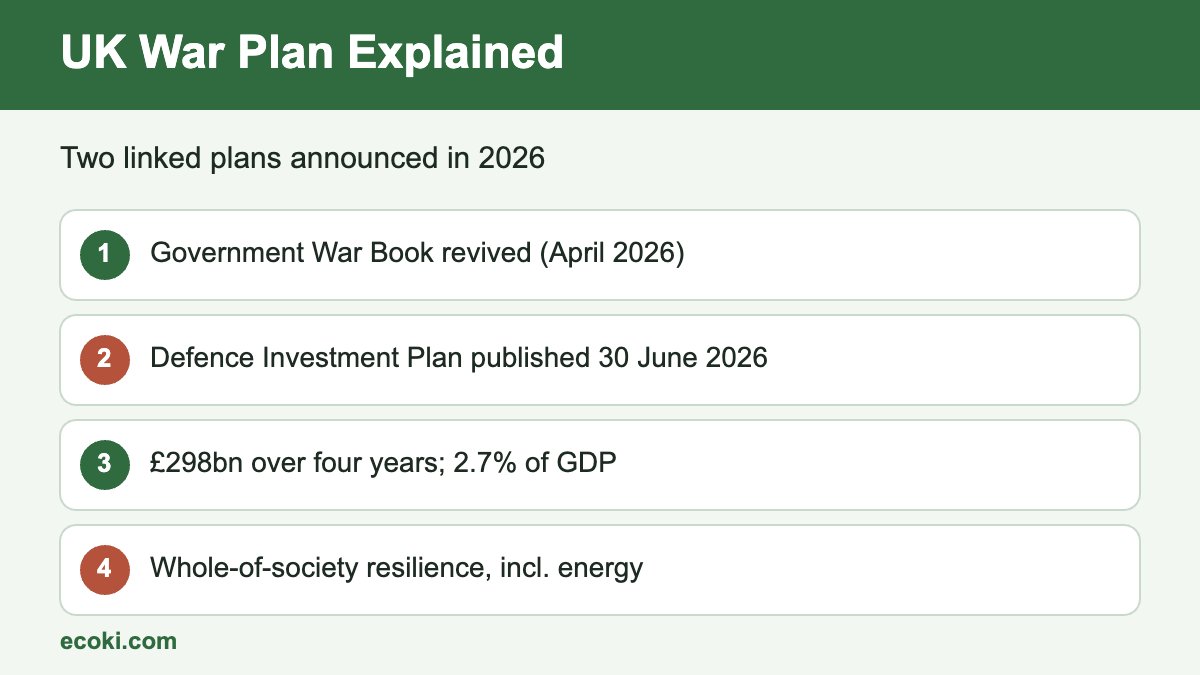
UK War Plan: The Short Version
| Government War Book (revived) | Defence Investment Plan | |
|---|---|---|
| What it is | A national contingency plan for transition to war | A four-year spending and procurement blueprint for the armed forces |
| Announced | April 2026 (Chief of the Defence Staff interview) | Published 30 June 2026 |
| Scope | Whole of government and society: health, transport, energy, industry, police, communications | Ministry of Defence equipment, munitions, people and infrastructure |
| Key numbers | Not a spending plan | £298bn over four years; ~£80bn a year by 2029; 2.7% of GDP |
| Public detail | Largely confidential by nature | Published document |
What Was the Government War Book?
During the Cold War, the UK kept a Government War Book: a detailed manual setting out what every department should do as a crisis escalated toward war. It covered everything from moving government functions and protecting key infrastructure to managing food, fuel, communications and emergency powers. Officials rehearsed it in exercises.
After the Cold War ended, the system was gradually shelved, and by the early 2000s it had effectively lapsed. Emergency planning shifted toward terrorism, pandemics, flooding and civil contingencies under laws such as the Civil Contingencies Act 2004.
Why bring it back now?
Knighton said the new plan would draw on Cold War lessons but be fitted to “a modern context, with a modern society, with modern infrastructure”. Modern Britain depends on things that barely existed in the 1980s: digital payment systems, cloud data, mobile networks, international energy interconnectors and just-in-time supply chains. Planning for a major conflict now means planning for cyber attacks, sabotage of undersea cables and pipelines, and disinformation, not just military operations.
What’s in the Defence Investment Plan?
The Defence Investment Plan sets out how the Ministry of Defence will spend its budget over four years. According to the published document, it is backed by £298 billion over that period, including £15 billion above the previous Spending Review settlement, with annual funding rising toward almost £80 billion by 2029 (GOV.UK). Legal and industry analysts summarised its priorities for defence suppliers (Clifford Chance; Janes).
Main themes reported include:
- Munitions and stockpiles: building sovereign production capacity so the UK isn’t dependent on imports in a long conflict.
- Long-range strike: weapons able to hit targets at greater distances.
- Drones and autonomous systems: large investment in uncrewed air, land and sea systems, reflecting lessons from Ukraine.
- Submarines and the nuclear deterrent: continued funding for the Dreadnought and AUKUS submarine programmes.
- Next-generation combat aircraft: the Global Combat Air Programme (GCAP) with Italy and Japan.
- Navy restructuring: some reports noted cancellations or changes to planned ship classes.
Spending as a share of GDP
| Target | Level | Timing (as stated) |
|---|---|---|
| Near-term | 2.7% of GDP | Reached under the Defence Investment Plan |
| Medium-term | 3% of GDP | Next Parliament |
| NATO core defence target | 3.5% of GDP | By 2035 |
| NATO total including resilience and security spending | 5% of GDP | By 2035 (agreed at the 2025 NATO summit) |
How This Builds on the 2025 Strategic Defence Review
In June 2025, the UK published a Strategic Defence Review (SDR) that said the armed forces should move to “warfighting readiness” and that national defence must involve the whole of society. Its headline commitments included building up to 12 new attack submarines under AUKUS, investing in munitions factories, and expanding drones and digital warfare. The Defence Investment Plan is meant to turn that review into funded programmes, and the revived War Book applies the “whole of society” idea across government.
What Would a Modern War Book Cover?
Details of contingency plans are mostly secret, but based on the old War Book and current resilience planning, a modern version would likely cover:
| Area | Example questions the plan must answer |
|---|---|
| Government continuity | Where and how do ministers and officials keep working if London is disrupted? |
| Energy | How are power, gas and fuel supplies protected and prioritised? |
| Health | How would the NHS handle mass casualties and protect supplies of medicines? |
| Transport | How are ports, rail and roads kept open for military and civilian needs? |
| Communications | How are networks, broadcasting and public alerts kept running? |
| Food and water | How are supply chains secured if imports are disrupted? |
| Industry | How quickly can factories switch to defence production? |
| Cyber and information | How are attacks on systems and disinformation campaigns handled? |
| Legal powers | Which emergency laws would apply, and with what safeguards? |
Energy Security Is Now Defence
One of the clearest lessons from the war in Ukraine is that energy infrastructure is a target. Power stations, substations and fuel depots have been attacked repeatedly, and Europe’s 2022 gas crisis showed how dependence on a hostile supplier becomes a weapon. For the UK, resilience planning increasingly overlaps with energy policy:
- Diversified supply reduces exposure to any single country.
- Home-grown renewables, such as offshore wind, can’t be cut off by a foreign supplier, though grids and cables still need protection.
- Distributed generation and storage, like rooftop solar and home batteries, make the system harder to knock out at a single point.
- Efficient buildings need less energy to stay warm in a supply shock.
That’s one reason energy efficiency matters beyond lower bills. Our guides to home energy audits, eco-friendly insulation and wind turbine output explain the practical side, and our explainer on whether natural gas is renewable covers why gas dependence is a strategic issue.
What Does It Mean for Ordinary People?
For most people, nothing changes day to day. A national contingency plan is about preparation, not a forecast. But the debate has raised practical questions:
- Household preparedness: several European governments, including Sweden and Finland, publish advice on keeping a few days of water, food, medicines, a battery radio and cash. The UK has published its own preparedness guidance online.
- Volunteering and reserves: expanding reserve forces and civil volunteer roles is part of most “whole of society” plans.
- Jobs and industry: higher defence spending means more contracts for shipyards, factories and tech firms, particularly in regions with defence clusters.
- Public finances: extra defence money has to come from somewhere: growth, borrowing, taxes or cuts elsewhere.
A simple household resilience checklist
- Water for three days (around 3 litres per person per day is a common guideline).
- Non-perishable food for several days.
- Essential medicines and a first-aid kit.
- A battery or wind-up radio, torch and spare batteries.
- A power bank for phones.
- Some cash in case card payments go down.
- Copies of important documents.
These steps are useful for storms, floods and power cuts as much as for any security crisis.
What Critics Say
- Funding gaps: some defence analysts argue part of the “new” money was already committed, and that the plan leaves programmes unfunded (Calibre Defence).
- Speed: critics, including opposition parties, have called the spending increases “too little, too late” given the threat assessment.
- Trade-offs: cancellations of some planned ships or programmes have worried parts of industry and the services.
- Civil liberties: any wartime contingency plan raises questions about emergency powers and oversight.
- Public engagement: some experts argue the UK lags Nordic countries in preparing citizens openly.
How the UK Compares With Other Countries
| Country | Approach to national preparedness |
|---|---|
| Finland | Long-standing “comprehensive security” model, conscription, extensive civil shelters |
| Sweden | “Total defence”, public preparedness brochure sent to every household |
| Germany | Rising defence spending and updated civil defence planning since 2022 |
| Poland | Among NATO’s highest spenders as a share of GDP, rapid army expansion |
| UK | Revived War Book, Defence Investment Plan, whole-of-society approach from the 2025 SDR |
Timeline: How UK Defence Planning Changed, 2022–2026
- February 2022: Russia launches its full-scale invasion of Ukraine. European governments begin reassessing defence and energy security.
- 2022–2023: The UK becomes one of the largest suppliers of military aid to Ukraine and updates its Integrated Review of security and foreign policy.
- June 2025: The Strategic Defence Review calls for “warfighting readiness” and a whole-of-society approach.
- June 2025: NATO allies agree at their summit in The Hague to aim for 5% of GDP on defence and security by 2035, with 3.5% on core defence.
- April 2026: The Chief of the Defence Staff says a new Government War Book is being prepared.
- 30 June 2026: The Defence Investment Plan is published, backed by £298 billion over four years.
Key Defence Programmes Explained
| Programme | What it is | Why it matters |
|---|---|---|
| Dreadnought | New class of ballistic-missile submarines carrying the UK’s nuclear deterrent | Replaces the Vanguard class to keep continuous at-sea deterrence |
| AUKUS | Security partnership with Australia and the U.S., including nuclear-powered attack submarines | Long-term submarine capability and industrial cooperation |
| GCAP | Global Combat Air Programme with Italy and Japan to build a next-generation fighter | Future air power and high-tech jobs |
| Munitions factories | New and expanded production of shells, missiles and explosives | Ukraine showed how quickly stockpiles run down |
| Drones and autonomy | Uncrewed air, land and maritime systems | Cheaper mass and reduced risk to personnel |
| Cyber and digital | Defensive and offensive cyber capabilities, secure networks | Modern conflict starts in cyberspace |
Myths and Facts
| Myth | Fact |
|---|---|
| “A war plan means war is coming.” | Contingency plans exist so a country can respond calmly if a crisis happens. Many countries have them permanently. |
| “It’s only about the military.” | The War Book is mainly about civilian systems: health, energy, transport, communications and supplies. |
| “All £298bn is new money.” | The figure covers the full four-year defence budget; only part of it is additional to earlier plans. |
| “Conscription is being introduced.” | There’s no current plan for compulsory service in the UK. |
| “Ordinary people can’t do anything.” | Household preparedness and resilient local energy genuinely help in any emergency. |
The Economic Side: Defence Spending and Jobs
Higher defence budgets affect the wider economy. Shipyards in Scotland and the North West, aerospace sites in Lancashire and the South West, and electronics and software firms across the country all depend on defence contracts. Supporters argue that investment in skills and manufacturing creates long-term benefits. Critics point out that every pound spent on defence is a pound not spent on other priorities, unless it’s funded by growth.
For investors, defence companies have attracted renewed interest across Europe since 2022. Some sustainability-focused funds that once excluded weapons makers have revisited their rules, which has sparked debate about how defence fits with ESG investing. Our explainer on what makes a business sustainable covers how such criteria are usually defined.
Glossary
| Term | Meaning |
|---|---|
| Government War Book | A national plan setting out actions for each department in a transition to war |
| Defence Investment Plan | The MoD’s multi-year plan for funding equipment, munitions and infrastructure |
| Strategic Defence Review | A periodic review of defence priorities; the latest UK version was published in June 2025 |
| Deterrence | Discouraging attack by making its costs clearly too high |
| Resilience | A society’s ability to absorb shocks and keep essential services running |
| Whole-of-society defence | An approach involving government, business and citizens, not only the armed forces |
Frequently Asked Questions
Is the UK preparing for war?
The UK is preparing for the possibility of war, not predicting one. Military leaders say a revived Government War Book will help the country move to a war footing if needed, and the Defence Investment Plan raises spending. Both aim to deter aggression by showing the country is ready.
What is the Government War Book?
The Government War Book was a Cold War-era manual telling every government department what to do as a crisis escalated toward war, covering continuity of government, infrastructure, supplies and emergency powers. It lapsed after the Cold War. In 2026, military leaders said a modern version is being prepared.
How much is the UK spending on defence?
The Defence Investment Plan published in June 2026 is backed by £298 billion over four years, with annual defence funding rising from about £54 billion to almost £80 billion by 2029 and spending reaching 2.7% of GDP. The government has stated aims of 3% in the next Parliament and 3.5% by 2035.
Will there be conscription in the UK?
There’s no current plan for compulsory military service in the UK. Debate has focused on expanding reserves, cadets and voluntary national service schemes. Some European countries, including Finland and Sweden, use conscription, but UK policy has so far centred on volunteers.
What should households do to prepare?
Basic resilience steps are sensible for any emergency: keep a few days of water and food, essential medicines, a battery radio, torch, power bank, some cash and copies of key documents. These help during storms, floods and power cuts, which are far more likely than conflict.
Is the Government War Book public?
No. By its nature, a national war contingency plan is largely classified, because publishing details would help potential adversaries. What’s public is the fact that it is being prepared and its broad purpose. Elements such as household preparedness advice and published defence strategies are available openly on GOV.UK.
What is the Defence Investment Plan?
The Defence Investment Plan is the Ministry of Defence’s four-year blueprint, published on 30 June 2026, setting out how about £298 billion will be spent on equipment, munitions, people and infrastructure. It aims to turn the 2025 Strategic Defence Review’s priorities into funded programmes.
Why does energy matter for national defence?
Modern militaries, hospitals, communications and industry all depend on reliable power and fuel. Attacks on energy infrastructure in Ukraine and Europe’s 2022 gas crisis showed how energy can be targeted or used as leverage. Diverse, domestic and efficient energy systems make a country harder to coerce.
How does UK defence spending compare with other NATO countries?
At around 2.7% of GDP under the 2026 plan, the UK sits above NATO’s older 2% guideline but below frontline states such as Poland and the Baltic countries. All allies have agreed to work toward 3.5% on core defence by 2035, so most European budgets are rising.
The Bottom Line
The “UK war plan” is really two things: a revived Government War Book to coordinate the whole country in a crisis, and a £298 billion Defence Investment Plan to rebuild the armed forces over four years. Both are about deterrence and resilience rather than an imminent threat. For citizens, the most useful takeaway is practical: a resilient country is built from resilient homes, energy systems and communities as well as from soldiers and equipment.