
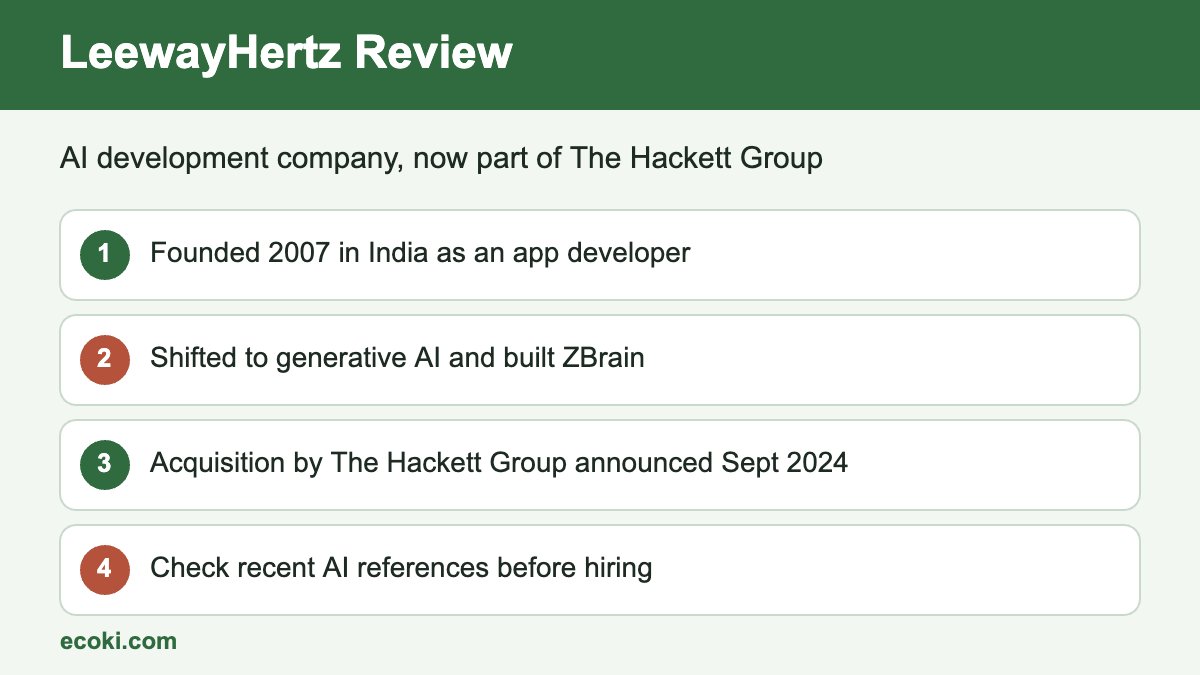
LeewayHertz is a software and AI development company that builds custom generative AI solutions, enterprise apps and its own AI orchestration platform, ZBrain. Founded in India in 2007, it began as an app and blockchain developer and later shifted its focus to AI. In September 2024, U.S.-listed consultancy The Hackett Group (NASDAQ: HCKT) announced a strategic acquisition of LeewayHertz and a joint venture around ZBrain (Business Wire).
If you’re considering LeewayHertz as a development partner, this review covers what the company does, its history, its platform, what independent reviews say, how it compares with alternatives, and the questions to ask before you sign.
LeewayHertz at a Glance
| Founded | 2007 (per business directories) |
|---|---|
| Founder | Akash Takyar |
| Main operations | India (Gurugram listed as headquarters in directories), with a U.S. presence |
| Team size | Directories list roughly 170 to 499 people; figures vary by source |
| Focus | Generative AI development, AI consulting, enterprise software |
| Own product | ZBrain, a low-code generative AI orchestration platform |
| Ownership | Acquired by The Hackett Group, announced September 2024 |
| Public reviews | Small number on Clutch and GoodFirms, mostly positive |
What Does LeewayHertz Do?
LeewayHertz sells custom development services, mainly to companies that want to build AI into their products or internal processes. Its public service pages group the work into several areas.
Generative AI development
Building applications on top of large language models: chatbots and assistants, document analysis, content generation, internal knowledge search and AI agents that carry out multi-step tasks.
AI consulting and strategy
Workshops to identify use cases, assess data readiness, choose models and estimate return on investment before any code is written.
Machine learning and data work
Predictive models, computer vision and data pipelines. This is classic supervised learning work for forecasting, classification and detection tasks.
Enterprise software and apps
Web and mobile app development, which was the company’s original business.
Blockchain development
LeewayHertz was an active blockchain developer in the late 2010s. Many of its older public case studies and reviews relate to this work rather than to AI.
What Is ZBrain?
ZBrain is LeewayHertz’s own platform for building and orchestrating generative AI applications with less custom code. It is positioned as an enterprise tool for connecting company data to large language models, building AI agents and deploying them into business workflows.
When The Hackett Group announced the deal, it said the two companies would form a joint venture combining Hackett’s AI XPLR platform with ZBrain, with Akash Takyar as CEO of the venture (Business Wire). Hackett’s SEC filings state that it committed to fund up to $10.0 million of development costs related to the ZBrain platform (SEC filing).
Hackett later rang the NASDAQ opening bell in November 2024 to mark the acquisition (Business Wire).
LeewayHertz History: From Apps to AI
- 2007: Company founded in India as a software and app development firm.
- 2010s: Builds mobile apps for startups and enterprises; becomes known for blockchain development later in the decade.
- Early 2020s: Shifts its marketing and services toward AI and generative AI; launches ZBrain.
- September 2024: The Hackett Group announces a strategic acquisition and ZBrain joint venture.
- November 2024: Hackett celebrates the deal at the NASDAQ opening bell.
What Do Independent Reviews Say?
Public review volume for LeewayHertz is small, so treat any average rating with caution.
| Platform | What we found | Caveat |
|---|---|---|
| Clutch | A rating around 4.7/5 from a handful of verified reviews | Fewer than 10 reviews at the time of research |
| GoodFirms | Five reviews, all 5-star | Very small sample |
| Other directories (Sortlist, Krowdbase, G2) | Profiles exist; few or no reviews | Not enough data to judge |
Common praise
- Reliable communication and on-time delivery.
- Technical depth, especially on complex integrations.
- Willingness to propose solutions rather than just follow specs.
Common criticism
- Some reviews mention project-management friction and scope creep.
- Many reviews relate to older app or blockchain projects, not recent AI work.
- Pricing details are rarely public, so budgets are hard to compare upfront.
Our take: the reviews that exist are positive, but there are too few recent, AI-specific reviews to draw strong conclusions. Ask for references from projects completed in the last 12–18 months.
LeewayHertz Pricing
LeewayHertz does not publish a public price list. Like most custom development firms, it quotes per project. Directory listings for Indian AI development firms of this size commonly show hourly rates in the lower-to-middle range compared with U.S. or Western European agencies, but you should get a written estimate based on your scope.
Typical pricing models you can expect:
- Fixed price for a clearly defined proof of concept.
- Time and materials for evolving projects billed by hours used.
- Dedicated team where you pay monthly for a set group of developers.
- Platform licensing if you build on ZBrain rather than from scratch.
Pros and Cons of Working With LeewayHertz
| Pros | Cons |
|---|---|
| Long track record since 2007 | Few public AI-specific reviews |
| Backed by a NASDAQ-listed parent since 2024 | Ownership change may shift priorities and processes |
| Own platform (ZBrain) can speed up builds | Platform use may create vendor lock-in |
| Broad skills across AI, apps and blockchain | No public pricing |
| Offshore delivery can lower cost | Time-zone differences for U.S. and European clients |
LeewayHertz vs Alternatives
| Option | Best for | Trade-off |
|---|---|---|
| LeewayHertz | Custom gen-AI builds with a platform head start | Smaller public review base |
| Large consultancies (Accenture, Deloitte, Capgemini) | Enterprise-wide transformation, regulated industries | Much higher cost, slower |
| Large Indian IT services firms (Infosys, TCS, Wipro) | Big teams, long-term outsourcing | Less specialised, heavier processes |
| Boutique AI studios | Narrow, cutting-edge projects | Limited capacity |
| In-house team + cloud AI services | Long-term ownership of the product | Hiring is slow and expensive |
| Freelancers | Small prototypes | Higher delivery risk on complex work |
What the Hackett Acquisition Means for Clients
An acquisition can change how a services firm works, for better or worse. Here’s what to consider if you’re evaluating LeewayHertz now:
- Financial stability: being part of a listed company with public financial reporting generally lowers the risk of a vendor disappearing mid-project.
- Broader offer: Hackett is known for benchmarking and business-process consulting, so clients may get strategy and implementation from one group.
- Process changes: integration can bring new contracts, account managers or pricing structures. Confirm who your day-to-day contacts will be.
- Platform roadmap: with ZBrain in a joint venture, ask how the platform will be supported and priced over the next few years.
None of these are reasons to avoid the company, but they are good topics for your first call.
Who Should Consider LeewayHertz?
- Mid-sized companies wanting a generative AI pilot without building an internal AI team first.
- Enterprises already working with The Hackett Group, where the combined offer may simplify procurement.
- Teams that want a platform-based approach rather than fully bespoke code.
It may be a weaker fit if you need a very small, fixed-budget prototype (a freelancer may be cheaper) or if strict data-residency rules require an onshore-only team.
Questions to Ask Before Hiring Any AI Development Company
- Can you show two AI projects finished in the last 12 months, with client references?
- Who owns the code, the prompts and any fine-tuned models when the project ends?
- Which large language models will you use, and can we switch providers later?
- How will our data be stored and protected? Ask about encryption, access controls and where servers are located.
- How do you test AI output quality, including hallucinations and bias?
- What happens after launch? Clarify support, monitoring and the cost of changes.
- What is the exit plan if we stop using your platform?
- What are the running costs? Model usage (tokens), hosting and licences add up beyond the build fee.
Red Flags When Choosing an AI Partner
- Promises of specific accuracy or ROI before seeing your data.
- No clear answer on intellectual property ownership.
- Case studies with no named clients and no way to verify them.
- Pressure to commit to a long contract before a paid pilot.
- Vague answers about data security or compliance.
What a Typical Generative AI Engagement Looks Like
Most custom AI development firms, LeewayHertz included, follow a similar sequence. Knowing it helps you judge proposals and timelines.
| Phase | What happens | Typical length | Your team’s role |
|---|---|---|---|
| 1. Discovery | Workshops to define use cases, users, data sources and success metrics | 1–3 weeks | Provide domain experts and access to sample data |
| 2. Feasibility / proof of concept | A small working prototype on real data to test quality | 3–6 weeks | Review outputs and score them honestly |
| 3. Architecture | Choose models, retrieval method, hosting, security controls | 1–2 weeks | Security and IT sign-off |
| 4. Build | Integrations, user interface, guardrails, evaluation tests | 6–16 weeks | Regular demos and feedback |
| 5. Launch | Rollout to a limited group, then wider | 2–4 weeks | Training users, collecting feedback |
| 6. Operate and improve | Monitoring, prompt and model updates, cost control | Ongoing | Own the roadmap and budget |
Timelines are indicative and depend heavily on data quality and integration complexity. Projects slow down most often at step 2, when real data turns out messier than expected.
Common Generative AI Use Cases by Industry
Finance and insurance
Summarising claims, extracting data from documents, assisting analysts with research and drafting customer replies under compliance rules.
Healthcare
Drafting clinical notes, answering staff questions from internal protocols and organising unstructured records. These projects need strict privacy controls and clinical review.
Retail and e-commerce
Product description generation, shopping assistants, review summarisation and demand forecasting.
Manufacturing and energy
Maintenance assistants that search manuals, analysis of sensor alerts and reporting on energy use. Companies working toward greener operations also use AI to track and report sustainability data; see our guide to what makes a sustainable business.
Legal and professional services
Contract review, clause comparison and knowledge search across past work, always with a human reviewer.
Build vs Buy vs Platform: Which Route Fits?
| Route | How it works | Pros | Cons |
|---|---|---|---|
| Buy off-the-shelf | Subscribe to an existing AI SaaS tool | Fast, low upfront cost | Limited customisation, data leaves your control |
| Platform-based build | Use a platform such as ZBrain and configure it | Faster than custom, still tailored | Licence costs, possible lock-in |
| Fully custom build | Developers write the application around chosen models | Maximum control and ownership | Slowest and most expensive upfront |
A useful rule: buy for generic tasks (meeting notes, email drafting), build for tasks that touch your unique data or processes and create competitive advantage.
A Simple Scorecard for Comparing AI Vendors
Score each shortlisted vendor from 1 to 5 on these criteria, then weight them by what matters most to you:
| Criterion | What a “5” looks like |
|---|---|
| Relevant experience | Recent projects in your industry with contactable references |
| Technical approach | Clear architecture, evaluation plan and model-choice reasoning |
| Security and compliance | Documented controls, certifications, data-residency options |
| Ownership terms | You own code, prompts and fine-tuned models |
| Cost transparency | Build fee plus realistic running costs spelled out |
| Communication | Named project lead, regular demos, overlap in working hours |
| Exit options | Documented handover and no punitive lock-in |
Key Terms You’ll Hear in AI Proposals
- LLM (large language model): the AI model that generates text, such as GPT-type or open-source models.
- RAG (retrieval-augmented generation): the model looks up your documents before answering, reducing made-up answers.
- Fine-tuning: further training a model on your examples to adjust its behaviour.
- Agent: an AI system that plans and carries out multi-step tasks using tools.
- Guardrails: rules and filters that block unsafe or off-topic outputs.
- Evaluation set: a fixed list of test questions with expected answers, used to measure quality over time.
- Tokens: the units models are billed by; roughly parts of words.
Is LeewayHertz Legit?
Yes. LeewayHertz is a real, long-running company, and its acquisition by a NASDAQ-listed firm is documented in press releases and SEC filings. That doesn’t guarantee a good fit for your project, but it does rule out the “fly-by-night agency” risk. As with any vendor, judge it on recent references, a paid pilot and a clear contract.
How to Run a Low-Risk Pilot With an AI Vendor
- Pick one narrow use case, such as answering internal policy questions or summarising support tickets.
- Define success numbers upfront: answer accuracy on a test set, time saved per task, user satisfaction.
- Limit the pilot to 6–10 weeks with a fixed budget.
- Use real but non-sensitive data first.
- Insist on a handover: documentation, code access and a demo your team can run.
- Decide based on evidence, not on the demo alone.
The Energy Side of Generative AI Projects
Every AI query uses electricity in a data centre. For a single chatbot the cost is modest, but for applications that process millions of documents, model choice matters. Ask any vendor whether a smaller model can meet your quality bar, whether results can be cached, and which cloud region will host the system. Efficient design lowers both your bill and your footprint. For a primer on how automated model selection works, see our guide to AutoML; for energy units, see kW vs kWh.
Frequently Asked Questions
Who owns LeewayHertz?
The Hackett Group, a NASDAQ-listed consulting firm, announced a strategic acquisition of LeewayHertz in September 2024. As part of the deal, the companies formed a joint venture around the ZBrain platform, led by LeewayHertz founder Akash Takyar as CEO, according to the official press release.
Where is LeewayHertz based?
Business directories list LeewayHertz’s headquarters in Gurugram (Gurgaon), India, and the company also markets services to clients in the United States and other countries. Its parent company, The Hackett Group, is headquartered in Miami, Florida.
What is ZBrain by LeewayHertz?
ZBrain is a low-code platform for building and orchestrating generative AI applications and agents. It connects company data to large language models so businesses can deploy AI assistants and automations faster than with fully custom code. It became part of a joint venture with The Hackett Group in 2024.
Is LeewayHertz good for small businesses?
It can be, but check the budget fit first. Directory data suggests a sizeable share of its clients are small and mid-sized firms. For very small prototypes, a freelancer or no-code tool may be cheaper; for complex integrations, an established firm reduces delivery risk.
How much does it cost to build an AI app?
Costs range widely. A simple chatbot prototype can cost a few thousand dollars, while an enterprise system with integrations, security reviews and ongoing support can reach six figures or more. Ask every vendor for a scoped estimate that includes model usage and hosting costs after launch.
What does LeewayHertz specialise in today?
Today LeewayHertz focuses mainly on generative AI: custom LLM applications, AI agents, enterprise knowledge assistants and AI consulting, alongside its ZBrain platform. It still offers broader software and app development, which was its original business before the shift to AI in the early 2020s.
Is ZBrain open source?
No. ZBrain is a commercial platform developed by LeewayHertz and now part of a joint venture with The Hackett Group. Pricing is provided on request. If open-source tooling is a requirement, ask the vendor which parts of a solution could be built on open frameworks instead.
The Bottom Line
LeewayHertz is an established development firm that has moved from apps and blockchain into generative AI, and its 2024 acquisition by The Hackett Group adds the backing of a listed parent. Public reviews are positive but few, so the safest route is a short paid pilot, recent references and a contract that spells out code ownership, data handling and running costs.