
The FTSE 100 (pronounced “footsie”) is the UK’s best-known stock market index. It tracks the 100 largest companies by market value listed on the London Stock Exchange’s main market, such as AstraZeneca, Shell, HSBC, Unilever and BP. It was launched on 3 January 1984 with a base value of 1,000 and is run by FTSE Russell, part of the London Stock Exchange Group (FTSE Russell).
Because most FTSE 100 companies are global businesses, the index is better understood as a basket of international giants that happen to be listed in London than as a pure measure of the UK economy. Below you’ll find how it’s calculated, what it contains, what moves it, how it compares with other indices and how people invest in it.
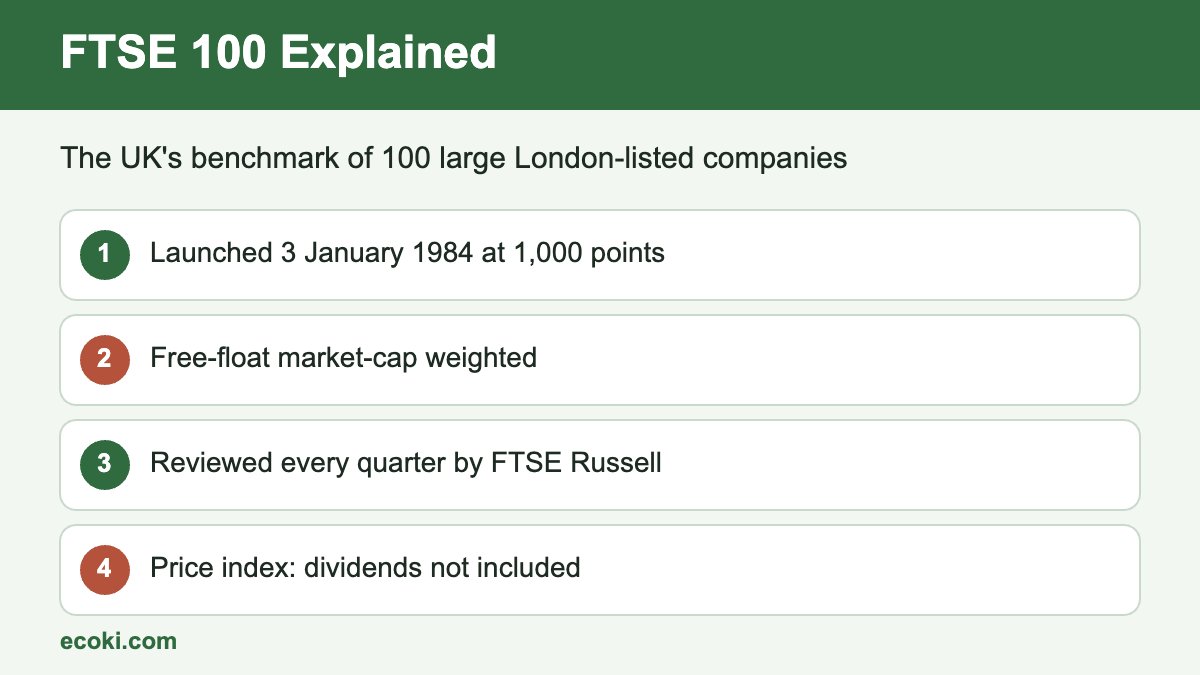
FTSE 100 Key Facts
| Full name | Financial Times Stock Exchange 100 Index |
|---|---|
| Nickname | “Footsie” |
| Launched | 3 January 1984 |
| Base value | 1,000 |
| Number of companies | 100 (occasionally 101 briefly due to share-class rules or corporate events) |
| Weighting | Free-float, market-capitalisation weighted |
| Index provider | FTSE Russell (London Stock Exchange Group) |
| Index type | Price index (a total-return version also exists) |
| Reviews | Quarterly, in March, June, September and December |
| Trading hours | 8:00 to 16:30 UK time, plus opening and closing auctions |
What Does “FTSE” Mean?
FTSE originally stood for Financial Times Stock Exchange, reflecting the joint venture between the Financial Times and the London Stock Exchange that created the index business. Today FTSE is a brand of FTSE Russell, wholly owned by the London Stock Exchange Group (LSEG), and the name is used across hundreds of indices worldwide.
A Brief History of the FTSE 100
- 1984: The FTSE 100 launches on 3 January at 1,000 points, replacing the older FT 30 as the main market benchmark.
- 1986: The “Big Bang” deregulation of the City of London brings electronic trading and foreign banks into the market.
- 1987: The October crash causes one of the index’s sharpest falls.
- 1999–2003: The dot-com boom and bust.
- 2008–2009: The global financial crisis hits banks and the wider index.
- 2016: After the Brexit referendum, a weaker pound boosts the sterling value of overseas earnings for many members.
- 2020: The Covid-19 pandemic triggers a sharp sell-off, followed by recovery.
How the FTSE 100 Is Calculated
The FTSE 100 is a free-float market-capitalisation-weighted index:
- For each company, multiply the share price by the number of shares available to public investors (free float).
- Add the values for all constituents.
- Divide by a divisor that keeps the index continuous through changes in membership and corporate actions.
The result: large companies have the most influence. A move in AstraZeneca or Shell shifts the index far more than the same percentage move in a company near the bottom of the list.
Price index, not total return
The headline FTSE 100 is a price index. It does not include dividends. That matters because the FTSE 100 has historically had a relatively high dividend yield, so the price index understates what investors actually earned. FTSE Russell also publishes a total-return version that includes reinvested dividends. Germany’s DAX index is the opposite: its headline figure already includes dividends.
How Companies Join and Leave the FTSE 100
FTSE Russell reviews membership every quarter. In simplified terms, the rules use a buffer to avoid constant churn:
- A company ranked 90th or higher by market value at a review is added if it isn’t already a member.
- A member that falls to 111th or lower is removed.
- Companies must meet eligibility tests on nationality, free float and liquidity, and be listed on the main market.
Companies that drop out usually move into the FTSE 250, the next tier of mid-sized companies. Exact rules are in FTSE Russell’s published ground rules, which are updated from time to time.
FTSE 100 Companies by Sector
| Sector | Examples |
|---|---|
| Pharmaceuticals and healthcare | AstraZeneca, GSK, Haleon |
| Energy | Shell, BP |
| Banks and financial services | HSBC, Barclays, Lloyds Banking Group, NatWest, London Stock Exchange Group |
| Consumer staples | Unilever, Diageo, Reckitt, British American Tobacco |
| Mining | Rio Tinto, Glencore, Anglo American |
| Industrials and defence | RELX, Rolls-Royce, BAE Systems |
| Utilities | National Grid, SSE |
| Retail and consumer | Tesco, Next, Associated British Foods |
| Telecoms | Vodafone, BT Group |
Membership changes every quarter, so check the current list on FTSE Russell’s or the London Stock Exchange’s website.
What the sector mix means
Compared with U.S. indices, the FTSE 100 has little big tech and lots of “old economy” sectors: energy, mining, banks, tobacco and consumer goods. That gives it a different personality. It tends to do relatively well when commodity prices and interest rates rise, and to lag when technology stocks lead global markets.
Why the FTSE 100 Isn’t the UK Economy
Many FTSE 100 companies earn the majority of their revenues outside the UK: oil majors sell globally, miners operate on several continents, and drugmakers sell worldwide. As a result:
- A weaker pound often lifts the FTSE 100, because overseas profits are worth more in sterling.
- Global commodity prices can matter more than UK consumer spending.
- The FTSE 250 is generally seen as a better gauge of the domestic UK economy, because its companies are more UK-focused.
The FTSE 100 and the Energy Transition
Two of the index’s heavyweights, Shell and BP, are oil and gas majors, and miners such as Glencore still have coal exposure. At the same time, National Grid and SSE are building out electricity networks and renewable generation. That mix makes the FTSE 100 a live example of the tension between today’s fossil-fuel profits and tomorrow’s low-carbon investment. For background on why gas is not a renewable fuel, see is natural gas renewable.
FTSE Russell also publishes ESG and low-carbon index variants for investors who want to tilt away from high-emission companies.
FTSE 100 vs Other Indices
| Index | Members | Weighting | Headline type | Character |
|---|---|---|---|---|
| FTSE 100 | 100 | Free-float market cap | Price | Global, high-dividend, commodity-heavy |
| FTSE 250 | 250 | Free-float market cap | Price | More UK-focused mid caps |
| FTSE All-Share | About 600 | Free-float market cap | Price | Broad UK market |
| DAX | 40 | Free-float market cap | Performance (with dividends) | German industrials, autos, finance |
| S&P 500 | About 500 | Float-adjusted market cap | Price | Tech-heavy U.S. large caps |
| Dow Jones Industrial Average | 30 | Price-weighted | Price | U.S. blue chips |
See our explainer on the Dow Jones Industrial Average for why its price weighting works differently.
What Moves the FTSE 100?
- Sterling: a weaker pound tends to lift the index; a stronger pound can weigh on it.
- Oil and metal prices: energy and mining stocks are big index weights.
- Interest rates: Bank of England decisions affect banks, housebuilders and valuations.
- Global growth: demand from China, the U.S. and Europe matters for miners and industrials.
- Large-company results: earnings from the top constituents can move the whole index.
- Dividend seasons: when big companies go “ex-dividend”, the price index drops by roughly the dividend amount.
FTSE 100 Trading Hours
The London Stock Exchange’s continuous trading runs from 8:00 to 16:30 UK time on weekdays, excluding bank holidays. An opening auction comes before 8:00 and a closing auction follows 16:30, which sets official closing prices. FTSE 100 futures and some broker products trade outside these hours, so prices quoted early in the morning or in the evening may not be the official index.
How to Invest in the FTSE 100
| Method | How it works | Best for | Watch out for |
|---|---|---|---|
| FTSE 100 ETF | Exchange-traded fund tracking the index | Low-cost, long-term investing | Fees, tracking difference |
| Index tracker fund | Unit trust or OEIC tracking the index | Monthly savings plans | Platform charges |
| Individual shares | Buy selected constituents | Investors who research companies | Concentration risk, UK stamp duty on share purchases |
| Investment trusts | Listed funds, some UK-equity focused | Income seekers | Discounts and premiums to asset value |
| Futures, options, spread bets, CFDs | Leveraged derivatives | Experienced traders | High risk of losses |
Tax wrappers in the UK
UK residents often hold FTSE 100 funds inside a Stocks and Shares ISA or a SIPP (self-invested personal pension), where gains and income are sheltered from tax within the allowances. Rules and allowances change, so check the latest HMRC guidance or speak to a regulated adviser.
Checklist before choosing a FTSE 100 tracker
- Ongoing charges figure (OCF): lower is better for a plain tracker.
- Tracking difference: how closely the fund has matched the index after costs.
- Accumulating vs income units: reinvest dividends or receive them.
- Fund size and liquidity.
- Platform fees, which can outweigh the fund’s own charge.
Dividends: The FTSE 100’s Hidden Engine
Because the headline index ignores dividends, it can look flat over long periods even when investors who reinvested dividends did reasonably well. A simple illustration: if prices rise 2% a year and dividends yield 3.5%, a price chart shows roughly 22% growth over ten years, while a reinvesting investor’s total would be roughly 71% (1.05510). These are hypothetical figures, not FTSE history, but they show why “the FTSE hasn’t gone anywhere” headlines can mislead.
Risks of Investing in the FTSE 100
- Sector concentration: energy, mining, banks and consumer staples make up a large share, while technology is small.
- Top-heavy weighting: the ten largest members account for a big slice of the index, so a few companies drive results.
- Commodity exposure: falling oil or metal prices can drag the index down even when the UK economy is fine.
- Currency effects: sterling movements change the value of overseas earnings and, for non-UK investors, the value of the investment itself.
- Dividend cuts: income investors rely on payouts that companies can reduce in tough years, as several did in 2020.
- General market risk: share prices can fall sharply and stay low for years.
How to Read FTSE 100 Headlines
News reports often say things like “FTSE 100 closes 1.2% lower as miners slide”. To make sense of them:
- Check the percentage, not the points. A 100-point move means less when the index is high.
- Look for the driver. Was it one sector, a currency move or a global sell-off?
- Note ex-dividend days. When several big companies go ex-dividend, the price index falls mechanically.
- Compare with the FTSE 250 to see whether domestic companies moved the same way.
- Zoom out. A single day rarely matters for long-term investors.
FTSE 100 for Beginners: A Simple Plan
- Decide what role UK shares should play in your portfolio, for example as one part of a global mix.
- Choose a platform with low fees for the amount you plan to invest.
- Pick a FTSE 100 or broader UK tracker with a low ongoing charge.
- Use a tax-efficient account if you’re eligible.
- Set up a regular monthly contribution so you don’t have to time the market.
- Reinvest dividends if you’re building wealth rather than drawing income.
- Review your mix once a year and rebalance if one part has grown too large.
Who Uses the FTSE 100?
- Pension funds and fund managers benchmark UK equity performance against it.
- Index funds and ETFs replicate it for millions of investors.
- Traders use FTSE 100 futures, options and spread bets to speculate or hedge.
- Journalists and economists quote it daily as shorthand for the London market.
- Companies value membership for visibility and steady demand from tracker funds.
FTSE 100 Glossary
| Term | Meaning |
|---|---|
| Constituent | A company included in the index |
| Free float | Shares available to public investors |
| Ground rules | FTSE Russell’s published methodology |
| Ex-dividend date | The date from which a buyer no longer receives the next dividend |
| Total return index | A version of the index that reinvests dividends |
| OCF | Ongoing charges figure, a fund’s annual cost |
| ISA | UK Individual Savings Account with tax advantages |
| Stamp duty | UK tax on purchases of UK shares (not on most ETF purchases) |
Common Misconceptions
- “The FTSE 100 is the UK economy.” It’s dominated by global businesses; the FTSE 250 is more domestic.
- “There are always exactly 100 companies.” Usually, but share-class rules and corporate events can briefly change the count.
- “A FTSE record means record returns.” The price index ignores dividends, so total returns tell a different story.
- “FTSE is a stock exchange.” FTSE Russell is an index provider; the London Stock Exchange is the exchange.
Comparing the FTSE 100 with US markets? See our guide to INDEXSP: .INX and the S&P 500, and our Charles Schwab review if you want a broker that gives access to both.
Frequently Asked Questions
What is the FTSE 100 in simple terms?
The FTSE 100 is a number that tracks the combined value of the 100 largest companies listed on the London Stock Exchange’s main market. When their share prices rise overall, the index rises. It’s used as a quick measure of how big UK-listed companies are performing.
Who decides which companies are in the FTSE 100?
FTSE Russell, part of the London Stock Exchange Group, applies published ground rules at quarterly reviews. Companies are ranked mainly by market value, with buffers to avoid constant changes: a non-member ranked 90th or higher generally joins, and a member that falls to 111th or lower generally leaves.
Does the FTSE 100 include dividends?
No. The headline FTSE 100 is a price index and excludes dividends. FTSE Russell publishes a separate total-return index that assumes dividends are reinvested. Over long periods the gap between the two is large because FTSE 100 companies have historically paid relatively high dividends.
How can I invest in the FTSE 100?
The simplest way is a low-cost FTSE 100 index fund or ETF bought through an investment platform, often inside an ISA or pension for UK residents. You can also buy individual shares. Compare fund charges and platform fees, and remember that values can fall as well as rise.
What is the difference between the FTSE 100 and FTSE 250?
The FTSE 100 covers the 100 largest companies, many of them multinationals. The FTSE 250 covers the next 250 by size, which are typically more focused on the UK economy. Investors often watch the FTSE 250 as a better signal of domestic business conditions.
Why is the FTSE 100 called the “Footsie”?
“Footsie” is simply a nickname based on how “FTSE” sounds when spoken aloud. The letters originally stood for Financial Times Stock Exchange, after the two organisations that created the index business. The nickname is now used widely in UK news and markets.
What time does the FTSE 100 open?
Continuous trading on the London Stock Exchange runs from 8:00 to 16:30 UK time on weekdays, with an opening auction before 8:00 and a closing auction after 16:30. The exchange is closed on weekends and UK bank holidays, so the index isn’t calculated then.
Is the FTSE 100 a good investment for income?
The FTSE 100 has historically offered a higher dividend yield than many other major indices, which appeals to income investors. However, dividends aren’t guaranteed and can be cut in downturns. Diversifying across regions and sectors helps reduce reliance on a few large dividend payers.
Can non-UK residents invest in the FTSE 100?
Yes. Many international brokers offer FTSE 100 ETFs listed in London or in other markets. Check the fund’s currency, the costs of converting money, and how your home country taxes foreign dividends. Non-UK investors also carry currency risk from changes in the value of the pound.
The Bottom Line
The FTSE 100 is a free-float, market-cap-weighted price index of London’s 100 biggest listed companies, heavy in energy, mining, banks, pharma and consumer staples. It reflects global business and the pound as much as the UK economy. If you invest in it, look at total returns rather than the headline level, keep costs low and consider how its sector mix fits with the rest of your portfolio.
Many readers look up FTSE 100 coverage on finance news aggregators. If you use one of them, read our FintechZoom review first to see whether FintechZoom is legit, how the .io and .com sites differ and how far you can trust their numbers.