
The Dow Jones Industrial Average (DJIA), usually just called “the Dow”, is a stock market index of 30 large, well-known U.S. companies, such as Apple, Microsoft, JPMorgan Chase, Coca-Cola and Walmart. First published on 26 May 1896 by Charles Dow, it is one of the oldest market indices in the world. Unlike most modern indices, the Dow is price-weighted: companies with higher share prices have more influence, regardless of their total size. It is maintained by S&P Dow Jones Indices (S&P Dow Jones Indices).
Below you’ll find how the Dow is calculated (and why its quirky method matters), its history, how members are chosen, how it compares with the S&P 500 and Nasdaq, and how investors gain exposure to it.
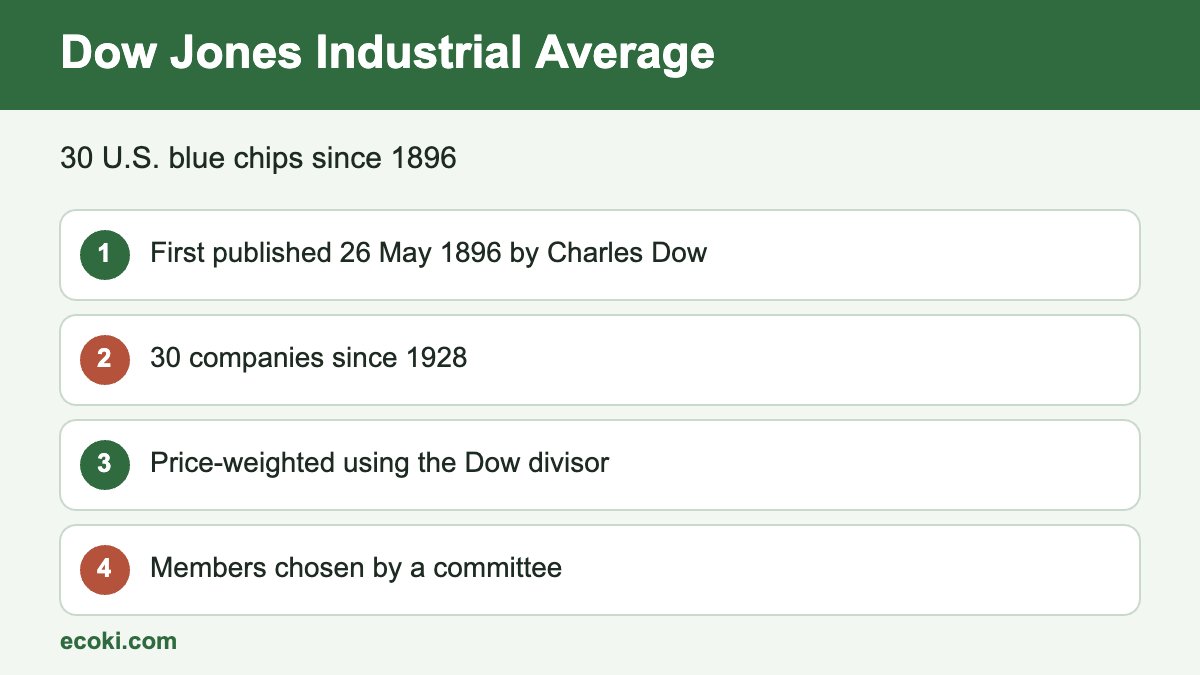
Dow Jones Industrial Average: Key Facts
| Ticker / symbol | Commonly ^DJI or .DJI (varies by data provider) |
|---|---|
| Number of companies | 30 |
| First published | 26 May 1896 |
| Founder | Charles Dow (with Edward Jones) |
| Original members | 12 companies |
| Expanded to 30 | 1928 |
| Weighting | Price-weighted, using the “Dow divisor” |
| Selection | By a committee, not a fixed formula |
| Index provider | S&P Dow Jones Indices |
| Index type | Price index (dividends excluded); total-return versions exist |
How the Dow Is Calculated: Price Weighting Explained
The Dow adds up the share prices of its 30 members and divides the total by a number called the Dow divisor. The divisor is adjusted whenever a company splits its stock, pays a special dividend or is replaced, so that these events don’t cause artificial jumps in the index.
Dow = (sum of the 30 share prices) ÷ Dow divisor
Because the divisor is well below 1, each $1 change in any member’s share price moves the Dow by several points. S&P Dow Jones Indices publishes the current divisor.
Why price weighting is unusual
In a price-weighted index, a company with a $500 share price has five times the influence of a company with a $100 share price, even if the cheaper-priced company is far bigger in total market value. That’s very different from the S&P 500 or the FTSE 100, which weight companies by market capitalisation.
A simple example
| Company | Share price | Market value | Influence in a price-weighted index | Influence in a market-cap index |
|---|---|---|---|---|
| A | $400 | $100 billion | High (expensive share) | Low |
| B | $50 | $2 trillion | Low (cheap share) | Very high |
This hypothetical shows why a stock split, which lowers a share price without changing the company’s value, reduces that company’s weight in the Dow. It’s also why companies with very high share prices are sometimes left out until they split their stock.
A Short History of the Dow
- 1896: Charles Dow publishes the first Industrial Average on 26 May with 12 companies, mostly in railroads-adjacent industry, commodities and manufacturing.
- 1916: The average expands to 20 companies.
- 1928: It expands to 30 companies, the number it still has today.
- 1929–1932: The Great Crash and Depression wipe out most of the Dow’s value; it takes until the 1950s to regain its 1929 peak.
- 19 October 1987: “Black Monday”: the Dow falls about 22.6% in a single day, its largest one-day percentage drop.
- 1999: Microsoft and Intel join, reflecting the rise of technology.
- 2008–2009: The global financial crisis brings a deep decline.
- 2018: General Electric, the last remaining member with roots in the original list, is removed.
- 2020: The Covid-19 crash and rebound produce some of the largest point swings in its history.
How Companies Are Chosen
The Dow has no strict size or ranking rule. Members are selected by the Averages Committee, which includes representatives of S&P Dow Jones Indices and The Wall Street Journal. The committee looks for companies that:
- Have an excellent reputation and a long record of growth.
- Are of interest to a large number of investors.
- Represent the broad U.S. economy (transport and utilities are covered by separate Dow averages).
- Have a share price that won’t distort the price-weighted index.
Changes are made only as needed, for example after a merger or when the committee wants better sector representation. That makes the Dow more editorial than rules-based indices.
Which Companies Are in the Dow?
The list changes occasionally, but the Dow typically includes companies across these sectors:
| Sector | Examples of Dow members |
|---|---|
| Technology | Apple, Microsoft, Cisco, IBM, Salesforce, Nvidia |
| Financials | JPMorgan Chase, Goldman Sachs, American Express, Visa, Travelers |
| Healthcare | UnitedHealth Group, Johnson & Johnson, Merck, Amgen |
| Consumer | Coca-Cola, McDonald’s, Walmart, Procter & Gamble, Nike, Home Depot, Disney |
| Industrials | Boeing, Caterpillar, Honeywell, 3M |
| Energy and materials | Chevron, Sherwin-Williams |
| Telecoms and e-commerce | Verizon, Amazon |
Always check the current constituents on S&P Dow Jones Indices’ site before relying on a list.
Dow vs S&P 500 vs Nasdaq
| Dow Jones Industrial Average | S&P 500 | Nasdaq Composite | |
|---|---|---|---|
| Companies | 30 | About 500 | Thousands (all Nasdaq-listed) |
| Weighting | Price | Float-adjusted market cap | Market cap |
| Selection | Committee, editorial | Committee, with published criteria | All eligible Nasdaq listings |
| Sector tilt | Blue-chip mix | Broad U.S. large caps, tech-heavy | Very tech-heavy |
| Used by professionals as benchmark | Less often | Most often | For tech and growth |
Most fund managers benchmark against the S&P 500 because it covers far more of the U.S. market and uses market-cap weighting. The Dow remains popular in the media because of its long history and familiar names. Our guide to the S&P 500 (INDEXSP: .INX) covers the broader index in detail.
Dow Points vs Percentages
Because the Dow is a high number, a move of hundreds of points can sound dramatic. What matters is the percentage. A 500-point fall means far less at a high index level than it did when the Dow was much lower. When you read “the Dow fell 400 points”, always check the percentage change to judge how big the move really was.
Other Dow Jones Averages
- Dow Jones Transportation Average: 20 transport companies, such as airlines, railroads and logistics firms. It’s actually older than the Industrial Average.
- Dow Jones Utility Average: 15 utility companies.
- Dow Jones Composite Average: combines the Industrial, Transportation and Utility averages.
- Dow Jones U.S. Total Stock Market Index: a broad market-cap index of U.S. shares.
Dow Theory, based on Charles Dow’s writings, suggests that a market trend is confirmed when the Industrial and Transportation averages move in the same direction. It’s a historical framework, not a reliable trading system on its own.
What Moves the Dow?
- High-priced members: because of price weighting, big moves in the most expensive shares dominate.
- Corporate earnings: results and forecasts from members.
- Federal Reserve policy: interest-rate decisions affect valuations across the market.
- Economic data: jobs reports, inflation and GDP releases.
- Energy prices: oil affects Chevron directly and costs for airlines, manufacturers and consumers.
- Global events: trade policy, conflicts and financial shocks.
The Dow and the Energy Transition
Over its history, the Dow has shifted from steel, railroads and oil toward technology, healthcare and finance, mirroring the U.S. economy. Today it contains relatively few fossil-fuel companies compared with a century ago. Energy still matters, though: data centres run by Dow tech giants use growing amounts of electricity, and the race to power them with renewables is a big business story. If you want to understand the units involved, see our kW vs kWh explainer, and for U.S. power prices by state, see electricity cost by state.
How to Invest in the Dow
| Method | How it works | Best for | Watch out for |
|---|---|---|---|
| Dow ETF (e.g. SPDR Dow Jones Industrial Average ETF, ticker DIA) | Holds the 30 stocks in the same price weights | Simple Dow exposure | Only 30 stocks, so less diversified |
| Individual Dow stocks | Buy selected members | Investors who research companies | Concentration risk |
| Broad U.S. index funds | S&P 500 or total-market funds | Long-term diversified investing | Not Dow-specific |
| Futures and options | Exchange-traded derivatives on the Dow | Experienced traders and hedgers | Leverage magnifies losses |
Many long-term investors prefer broad market funds over a Dow tracker because 30 stocks offer less diversification and price weighting is an arbitrary way to allocate money.
Strengths and Weaknesses of the Dow
| Strengths | Weaknesses |
|---|---|
| Long history back to 1896 | Only 30 companies |
| Easy to understand and widely reported | Price weighting ignores company size |
| Focus on established blue chips | Committee selection is subjective |
| Useful historical record of the U.S. economy | Stock splits can change weights without any change in value |
Dow Milestones Over Time
| Milestone | First reached (closing basis) | What was happening |
|---|---|---|
| 1,000 | November 1972 | Post-war growth era, before the 1973–74 bear market |
| 10,000 | March 1999 | The late-1990s tech boom |
| 20,000 | January 2017 | Long recovery after the financial crisis |
| 30,000 | November 2020 | Rebound from the pandemic crash |
| 40,000 | May 2024 | Rally led by large technology and AI-related companies |
Round-number milestones get headlines, but they’re psychologically rather than economically important. Notice how each additional 10,000 points requires a smaller percentage gain than the last.
“Dogs of the Dow”: A Famous Strategy
The Dogs of the Dow strategy, popularised in the 1990s, involves buying the 10 Dow stocks with the highest dividend yields at the start of each year, holding them for a year and then repeating. The logic is that high yields can signal temporarily out-of-favour blue chips.
Results have varied widely by period. It’s a simple, rules-based value approach, but it concentrates money in 10 stocks and can lag badly when growth companies lead the market. Treat it as an idea to research, not a guaranteed edge.
Dow Futures: Why the Dow Seems to Move Overnight
The official Dow is calculated during U.S. stock market hours, 9:30 a.m. to 4:00 p.m. Eastern Time. Before the open, news reports often quote Dow futures, which trade on the CME almost around the clock. Futures give a hint of where the index may open, but they aren’t the index itself, and the actual opening can differ.
Risks of Investing Through a Dow Tracker
- Low diversification: 30 companies can’t represent the whole U.S. market.
- Arbitrary weights: a company’s influence depends on its share price, not its size or profits.
- Split effects: when a member splits its stock, its weight falls even though nothing about the business changed.
- Sector gaps: some fast-growing industries may be under-represented until the committee adds them.
- General market risk: stock prices can fall sharply, as in 1929, 1987, 2008 and 2020.
Common Misconceptions About the Dow
- “The Dow is the market.” It’s 30 stocks, while U.S. exchanges list thousands.
- “Biggest companies matter most in the Dow.” Not necessarily; share price matters most.
- “Dow Jones is a company that runs the stock exchange.” Dow Jones & Company is a news and data business (publisher of The Wall Street Journal); the index is maintained by S&P Dow Jones Indices, and stocks trade on exchanges like the NYSE and Nasdaq.
- “Industrial” means factories only. Today the name is historical; members include banks, tech and healthcare companies.
Dow Glossary
| Term | Meaning |
|---|---|
| Dow divisor | The number used to convert summed share prices into the index level |
| Price-weighted | Weighting by share price rather than company value |
| Averages Committee | The group that selects Dow members |
| Blue chip | A large, established, financially sound company |
| Stock split | Dividing shares into more, cheaper shares without changing total value |
| DIA | Ticker of a widely held ETF tracking the Dow |
| Dow Theory | A trend-confirmation framework based on Charles Dow’s writings |
How to Read Dow Headlines
- Convert points to percent. Divide the point change by the previous close.
- Find out which members drove the move. In a price-weighted index, one or two high-priced stocks can account for most of the change.
- Compare with the S&P 500 and Nasdaq. If the Dow fell but the others rose, the move was probably narrow.
- Check for corporate events such as a stock split or a member change, which can alter the divisor and weights.
- Think in years, not days, if you’re a long-term investor.
Who Was Charles Dow?
Charles Henry Dow (1851–1902) was an American journalist who co-founded Dow Jones & Company in 1882 with Edward Jones and Charles Bergstresser, and helped launch The Wall Street Journal in 1889. He created stock averages to give readers a simple way to follow the market. His editorials laid the groundwork for what later became known as Dow Theory.
To buy a Dow or S&P 500 fund you need a brokerage account. Our Charles Schwab review explains one of the largest US options, with its fees, pros and cons.
Frequently Asked Questions
What is the Dow Jones in simple terms?
The Dow Jones Industrial Average is a number that tracks the share prices of 30 large U.S. companies. It adds their prices and divides by a special divisor. When those prices rise overall, the Dow rises. It’s one of the oldest and most quoted measures of the U.S. stock market.
Why does the Dow only have 30 stocks?
The Dow expanded to 30 companies in 1928 and has kept that number for continuity. It was designed as a simple snapshot of leading industrial companies when calculations were done by hand. Today the S&P 500 and total-market indices provide broader coverage of the U.S. market.
Who owns the Dow Jones Industrial Average?
The index is maintained by S&P Dow Jones Indices, a joint venture majority-owned by S&P Global. Members are chosen by the Averages Committee, which includes representatives of S&P Dow Jones Indices and The Wall Street Journal, the newspaper Charles Dow co-founded.
Is the Dow the same as the stock market?
No. The Dow covers just 30 companies out of thousands listed in the U.S., and it uses price weighting. It often moves in the same direction as the broader market, but the S&P 500 is a better representation of overall U.S. large-company performance.
What was the biggest drop in Dow history?
In percentage terms, the largest one-day fall was on Black Monday, 19 October 1987, when the Dow dropped about 22.6%. In points, the biggest single-day falls occurred during the 2020 pandemic sell-off, but those were smaller in percentage terms because the index level was much higher.
What time does the Dow open and close?
The Dow is calculated during regular U.S. stock market hours, from 9:30 a.m. to 4:00 p.m. Eastern Time on weekdays, excluding market holidays. Dow futures trade almost around the clock, so pre-market news often quotes futures rather than the official index level.
How often do Dow members change?
There’s no fixed schedule. The Averages Committee makes changes when needed, for example after a merger, an acquisition or when it wants to better reflect the economy. Some years see no changes, while others see several. Announcements are published by S&P Dow Jones Indices in advance.
Does the Dow include dividends?
No. The headline Dow is a price index, so dividends aren’t included. S&P Dow Jones Indices also calculates total-return versions that assume dividends are reinvested, which show noticeably higher long-term growth than the familiar price-only figure.
Can I buy the Dow directly?
Not directly, because an index is a calculation. You can buy an ETF that tracks it, such as one holding all 30 members in their price weights, or buy individual member shares through a brokerage account. Futures and options also offer exposure but carry higher risk.
The Bottom Line
The Dow Jones Industrial Average is a 130-year-old, price-weighted index of 30 blue-chip U.S. companies. It’s a great piece of market history and a handy daily headline, but its small size and unusual weighting mean it’s not the best measure of the whole market. Watch percentages rather than points, and if you’re investing for the long term, consider whether a broader index fund fits your goals better.
Many readers look up Dow Jones quotes on finance news aggregators. If you use one of them, read our FintechZoom review first to see whether FintechZoom is legit, how the .io and .com sites differ and how far you can trust their numbers.