
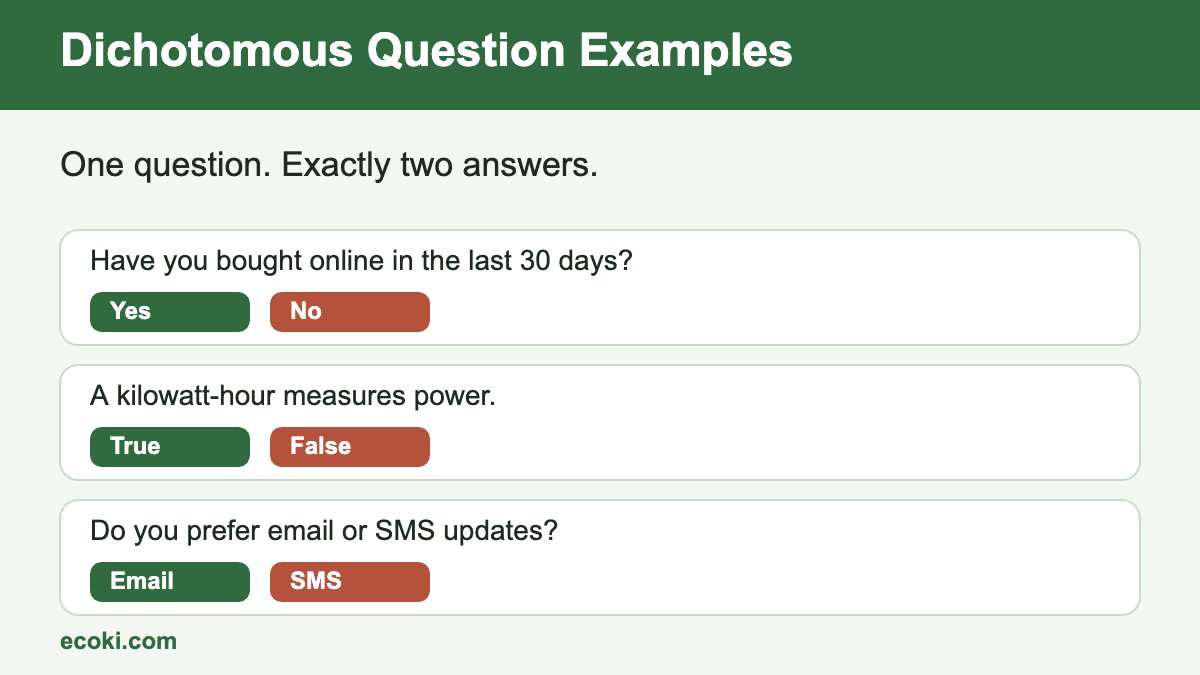
A dichotomous question is a closed-ended survey question with exactly two possible answers, such as Yes/No, True/False or Agree/Disagree. A classic example: “Have you bought a product online in the last 30 days?” (Yes / No). Use one when the answer really can only go two ways. If people need room for “sometimes” or “it depends”, a two-option question will give you bad data.
Below you’ll find 40+ ready-to-use examples by category, a sample questionnaire you can copy, what the research says about two-option formats, and the mistakes that quietly ruin results.
What Is a Dichotomous Question?
“Dichotomous” comes from the Greek for “cut in two”. In a survey, it means the respondent picks one of two mutually exclusive options. Nothing in between, no scale.
Three things define a good dichotomous question:
- Two options only. Adding “Not sure” technically makes it a three-option multiple-choice question.
- Mutually exclusive answers. A respondent can’t honestly pick both.
- Exhaustive answers. Every respondent fits into one of the two options.
The answers produce a binary variable (often coded 1 and 0), which makes the data easy to count, filter and cross-tabulate.
Types of Dichotomous Questions (With Examples)
| Type | Answer pair | Example | Best for |
|---|---|---|---|
| Yes / No | Yes, No | “Do you own a car?” | Facts, behaviour, screening |
| True / False | True, False | “A kilowatt-hour measures power.” | Knowledge checks, quizzes |
| Agree / Disagree | Agree, Disagree | “Our checkout was easy to use.” | Quick attitude checks (use with care) |
| Fair / Unfair | Fair, Unfair | “Was the price you paid fair?” | Pricing and policy feedback |
| Either / Or | Option A, Option B | “Do you prefer email or SMS updates?” | Preferences between two choices |
| Before / After, Above / Below | Two ranges | “Is your household income above or below $50,000?” | Splitting a population into two groups |
40+ Dichotomous Question Examples by Category
Customer Feedback
- Did you find what you were looking for today? (Yes / No)
- Was your order delivered on time? (Yes / No)
- Have you contacted our support team in the last 6 months? (Yes / No)
- Was your issue resolved on the first contact? (Yes / No)
- Would you buy from us again? (Yes / No)
- Did the product match its description? (Yes / No)
Market Research
- Have you heard of [Brand] before today? (Yes / No)
- Have you bought [product category] in the last 12 months? (Yes / No)
- Do you currently pay for a streaming subscription? (Yes / No)
- Do you prefer shopping online or in store? (Online / In store)
- Would you pay extra for a product made from recycled materials? (Yes / No)
Employee Surveys
- Do you know who to contact if you have a payroll issue? (Yes / No)
- Have you received training in the last 12 months? (Yes / No)
- Do you work remotely at least one day a week? (Yes / No)
- Do you have the tools you need to do your job? (Yes / No)
- Did you take all your annual leave last year? (Yes / No)
Education and Quizzes
- The Earth orbits the Sun once every 365.25 days. (True / False)
- Water boils at 100°C at sea level. (True / False)
- Did you complete the reading before class? (Yes / No)
- Would you recommend this course to a friend? (Yes / No)
- Was the pace of the lesson right for you? (Yes / No)
Health and Screening
- Do you currently smoke? (Yes / No)
- Are you taking any prescription medication? (Yes / No)
- Have you had a fever in the last 48 hours? (Yes / No)
- Do you have any known allergies? (Yes / No)
- Have you been vaccinated against the flu this season? (Yes / No)
Events and Registration
- Will you attend the event in person? (Yes / No)
- Do you need parking? (Yes / No)
- Do you have any dietary requirements? (Yes / No)
- Is this your first time attending? (Yes / No)
- Would you like to receive the slides afterwards? (Yes / No)
Sustainability and Home Energy
Two-option questions work well for green-behaviour surveys because most habits are either done or not done:
- Do you separate recyclables from general waste at home? (Yes / No)
- Has your home had an energy audit? (Yes / No) — see what one involves in our home energy audit cost guide.
- Do you know how many kWh your household uses per month? (Yes / No) — if not, our kW vs kWh explainer helps.
- Do you own solar panels? (Yes / No)
- Does your employer have a written sustainability policy? (Yes / No)
- Have you switched to LED bulbs throughout your home? (Yes / No)
Website and Product UX
- Was this page helpful? (Yes / No)
- Did you create an account during checkout? (Yes / No)
- Did you use the search bar to find this page? (Yes / No)
- Have you used our mobile app? (Yes / No)
- Did you find the pricing clear? (Yes / No)
Dichotomous Questionnaire Sample (Copy and Adapt)
This short customer questionnaire uses dichotomous questions as filters, then follows up where you need detail. It takes most people under two minutes.
| # | Question | Answers | Logic |
|---|---|---|---|
| 1 | Have you bought from us in the last 12 months? | Yes / No | No → go to Q6 |
| 2 | Did your most recent order arrive on time? | Yes / No | — |
| 3 | Did the product match its description? | Yes / No | No → Q3a |
| 3a | What was different from what you expected? | Open text | — |
| 4 | Did you contact customer support about this order? | Yes / No | No → go to Q5 |
| 4a | Was your issue resolved on the first contact? | Yes / No | — |
| 5 | Would you buy from us again? | Yes / No | End |
| 6 | Do you prefer shopping online or in store? | Online / In store | — |
| 7 | Would you like a discount code for your first order? | Yes / No | End |
Notice the pattern: the binary question decides who sees the next question, and an open-text follow-up captures the why.
What the Research Says About Two-Option Questions
Survey vendors often claim yes/no questions always improve data. The evidence is more mixed.
- Closed options shape answers. In a Pew Research Center poll after the 2008 U.S. presidential election, 58% picked “the economy” as their top issue when it was offered as an option, but only 35% volunteered it when the question was open-ended. In the open version, 43% gave an answer that wasn’t on the closed list at all (Pew Research Center).
- Agree/Disagree pairs invite “yes-saying”. Pew notes that less educated and less informed respondents are more likely to agree with statements, a pattern called acquiescence bias, and that it is stronger when an interviewer is present. Pew recommends offering a choice between two alternative statements instead (Pew Research Center).
- Item-specific options beat agree/disagree. A 2010 study by Saris, Revilla, Krosnick and Shaeffer, using randomised experiments in representative sample surveys, found that agree/disagree questions produced “much lower quality” data than comparable questions with item-specific answer options (Survey Research Methods).
- Short questions save real time. SurveyMonkey analysed about 100,000 surveys of 1–30 questions. Respondents spent about 75 seconds on the first question and roughly 5 minutes on a 10-question survey (SurveyMonkey). Quick binary items help keep the total down.
The practical takeaway: a Yes/No question about a fact or behaviour (“Did you…?”, “Do you own…?”) is usually reliable. A Yes/No or Agree/Disagree question about an opinion is where bias creeps in.
Advantages and Disadvantages
| Advantages | Disadvantages |
|---|---|
| Fast to answer, especially on mobile | No room for nuance or “it depends” |
| Easy to analyse and chart | Prone to acquiescence bias in agree/disagree form |
| Ideal for screening and skip logic | Forces a choice when neither option fits |
| Clear, comparable data across groups | Tells you what, rarely why |
| Low effort keeps completion rates up | Easy to write leading versions by accident |
When to Use (and Avoid) Dichotomous Questions
Use them when
- The answer is factual: owned or not, attended or not, happened or not.
- You need to screen respondents or route them with skip logic.
- You want a quick pulse check, such as “Was this page helpful?”
- You’re running a knowledge test with clear right and wrong answers.
Avoid them when
- Opinions sit on a spectrum. Use a Likert or rating scale instead.
- Many respondents will genuinely be unsure.
- You need to understand reasons or motivations. Add an open-ended follow-up.
- The topic is sensitive and a forced choice may push people to quit or answer dishonestly.
How to Write Good Dichotomous Questions
- Ask about one thing. “Was delivery fast and the packaging good?” is two questions. Split it.
- Stay neutral. “Don’t you agree our service is excellent?” leads people. Ask “Was our service satisfactory?”
- Set a time frame. “Have you flown in the last 12 months?” beats “Do you fly?”
- Replace agree/disagree with alternatives. Instead of “I prefer email. Agree/Disagree”, ask “Do you prefer email or SMS?”
- Avoid negatives. “Do you not use public transport?” confuses people. Ask it positively.
- Follow up when it matters. After a “No”, ask “What could we improve?” in an open text box.
- Test it. Have three people answer it out loud. If anyone hesitates between options, rewrite it.
Dichotomous vs Other Question Types
| Question type | Answer format | Example | Use it for |
|---|---|---|---|
| Dichotomous | 2 fixed options | “Do you own a bike?” Yes/No | Facts, screening |
| Multiple choice | 3+ fixed options | “How do you commute?” Car/Bus/Bike/Walk | Categories |
| Likert scale | 5–7 point agreement scale | “The app is easy to use” Strongly disagree → Strongly agree | Attitudes with intensity |
| Rating scale | Numeric (e.g. 0–10) | “How likely are you to recommend us?” | Satisfaction, NPS |
| Open-ended | Free text | “What should we improve?” | Reasons, ideas |
Dichotomous Questions in Research and Statistics
In research, a dichotomous question creates a binary (dichotomous) variable. Analysts usually code “Yes” as 1 and “No” as 0. That lets you:
- Report simple percentages, such as the share of respondents who answered “Yes”.
- Compare groups with a chi-square test.
- Use the answer as the outcome in a logistic regression.
Businesses use the same idea when measuring things like whether they meet a sustainability standard. Our guide to what a sustainable business is shows how many of those checks come down to clear yes/no criteria.
Good vs Bad Dichotomous Questions: 8 Rewrites
Most bad yes/no questions fail in the same few ways. Here is how to fix them:
| Bad version | Problem | Better version |
|---|---|---|
| “Was the staff friendly and quick?” | Two questions in one | “Was the staff friendly?” + “Were you served within 5 minutes?” |
| “Don’t you think recycling matters?” | Leading | “Do you recycle at home?” |
| “Do you exercise?” | No time frame | “Did you exercise for 30+ minutes in the last 7 days?” |
| “Do you not use a car?” | Negative wording | “Do you use a car at least once a week?” |
| “Are you satisfied?” | Opinion forced into two boxes | Use a 5-point satisfaction scale |
| “Is your income high?” | Vague term | “Is your household income above $50,000 a year?” |
| “Agree or disagree: I prefer email.” | Invites acquiescence | “Do you prefer email or SMS?” |
| “Have you ever broken the law?” | Sensitive, likely to cause drop-off | Make it optional and add “Prefer not to say” |
How to Analyse Dichotomous Survey Data
Binary answers are the easiest data type to analyse. A simple four-step process works for most surveys:
- Code the answers. Yes = 1, No = 0. Keep blanks as missing, not as 0.
- Calculate the proportion. Divide the number of “Yes” answers by the number of people who answered the question.
- Add a margin of error. For a proportion, the 95% margin of error is roughly 1.96 × √(p × (1 − p) / n).
- Compare groups. Cross-tabulate by age, region or customer type, and use a chi-square test to see if the difference is likely to be real.
Worked example (hypothetical numbers)
Say 400 people answer “Do you separate recyclables at home?” and 260 say Yes.
- Proportion: 260 / 400 = 0.65, or 65%.
- Margin of error: 1.96 × √(0.65 × 0.35 / 400) ≈ 0.047, or about ±4.7 points.
- Result: between roughly 60% and 70% of the population you sampled recycle at home, assuming a random sample.
If you then split by homeowners vs renters and see 72% vs 55%, a chi-square test tells you whether that gap is bigger than chance would explain.
Dichotomous Questions by Field
Healthcare and Screening
Clinical intake forms rely on yes/no items because each answer triggers a clear next step. “Do you have a known allergy to penicillin?” either changes the prescription or it doesn’t. The key is precise wording and a defined time window.
HR and Compliance
Compliance checklists (“Have you completed the annual data-protection training?”) are almost entirely dichotomous. They are auditable: a person either did it or didn’t. Pair them with a date field where proof matters.
Education
True/False quizzes are fast to mark, but a student who guesses gets about half right by chance. Teachers often add “explain your answer” or use more items to reduce the effect of guessing.
Product and UX Research
“Was this page helpful? Yes/No” widgets collect huge volumes of feedback because they take one click. Treat them as a signal for which pages to look at, then use interviews or open text to learn why.
Sustainability Audits
Green building and business audits are built from binary checks: “Is there a recycling station on every floor?”, “Are lights on motion sensors?”. If you’re planning upgrades, our guides to eco-friendly insulation and eco-friendly roofing show what those checks usually lead to.
Should You Add a “Don’t Know” Option?
Adding a third option breaks the strict dichotomy, but it is sometimes the honest choice.
- Add it for knowledge questions and for anything people may not remember, such as “Has your boiler been serviced in the last year?”
- Add “Prefer not to say” for sensitive topics like health, income or legal history.
- Leave it out for simple facts the person certainly knows, such as “Do you own a car?”
If you add it, report “Don’t know” separately. Don’t quietly merge it into “No”.
Dichotomous Question vs Dichotomous Key
Many people searching this term are actually looking for a dichotomous key, a biology tool. A dichotomous key identifies an organism through a series of paired statements, such as “Leaves are needle-shaped” vs “Leaves are broad”. Each choice leads to the next pair until you reach a name.
The logic is the same as a survey with skip logic: every step offers two options and routes you onward. The goal is different. A key identifies one thing, while a survey measures many people.
Tools for Creating Dichotomous Questions
| Tool | How to make a dichotomous question | Skip logic |
|---|---|---|
| Google Forms | “Multiple choice” with two options | Yes, “Go to section based on answer” |
| Microsoft Forms | “Choice” with two options | Yes, branching |
| SurveyMonkey | “Multiple choice” with two answers | Yes, on paid plans |
| Typeform | Dedicated “Yes/No” question type | Yes, logic jumps |
Dichotomous answers are also how many machine learning datasets are labelled. Our guide to supervised learning shows how yes/no data trains a binary classifier.
Frequently Asked Questions
What is an example of a dichotomous question?
“Have you visited our store in the last month? (Yes / No)” is a typical dichotomous question. It has exactly two answers that don’t overlap, and every respondent fits one of them. Other common pairs are True/False, Agree/Disagree and Fair/Unfair.
Is a yes/no question always dichotomous?
Yes, as long as only “Yes” and “No” are offered. Once you add “Don’t know” or “Prefer not to say”, it becomes a multiple-choice question. That is often a good idea for sensitive topics, but the data is no longer strictly binary.
Are dichotomous questions open or closed-ended?
They are closed-ended. Respondents choose from a fixed set of two answers rather than writing their own. That makes them quick to answer and easy to analyse, but they can’t capture reasons. Pair them with an open-ended follow-up when you need the “why”.
What is a dichotomous scale?
A dichotomous scale is a measurement with two points, such as 0 and 1, or Yes and No. It records whether something is present or absent. It is the simplest type of nominal scale and can’t show how strongly someone feels, which a Likert scale can.
Can a dichotomous question have more than two answers?
No. By definition it has exactly two. Once you add a third option such as “Not sure”, it becomes a multiple-choice question. That can still be a good design choice, but you should analyse and report it as a three-category variable rather than a binary one.
Are dichotomous questions qualitative or quantitative?
The answers are categorical, so they are technically qualitative (nominal) data. Once coded as 1 and 0, though, you can count them and calculate percentages, margins of error and statistical tests. That is why they are widely used in quantitative surveys.
What is an example of a dichotomous variable?
Common examples are smoker vs non-smoker, passed vs failed, employed vs unemployed, and owns a home vs rents. Each person falls into exactly one group. In data analysis these are usually stored as 1 and 0 to make counting and modelling simple.
Final Thoughts
Dichotomous questions are the fastest way to get clean, countable answers, as long as the question really has two answers. Use them for facts, screening and quick checks. Switch to scales or open text when opinions are involved, and avoid agree/disagree wording where you can. Start with the sample questionnaire above, adapt the examples to your topic, and test every question on a few real people before you send it.