
The DAX index (Deutscher Aktienindex) is Germany’s main stock market index. It tracks the 40 largest and most liquid companies listed on the Frankfurt Stock Exchange, such as SAP, Siemens, Allianz, Deutsche Telekom and Mercedes-Benz Group. It was first published on 1 July 1988 with 30 companies and expanded to 40 members in September 2021 (Deutsche Börse).
One detail surprises many investors: the headline DAX is a performance (total return) index. It assumes dividends are reinvested, unlike the S&P 500 or FTSE 100 headline figures, which are price indices. That makes the DAX look stronger over long periods than an apples-to-apples price comparison would.
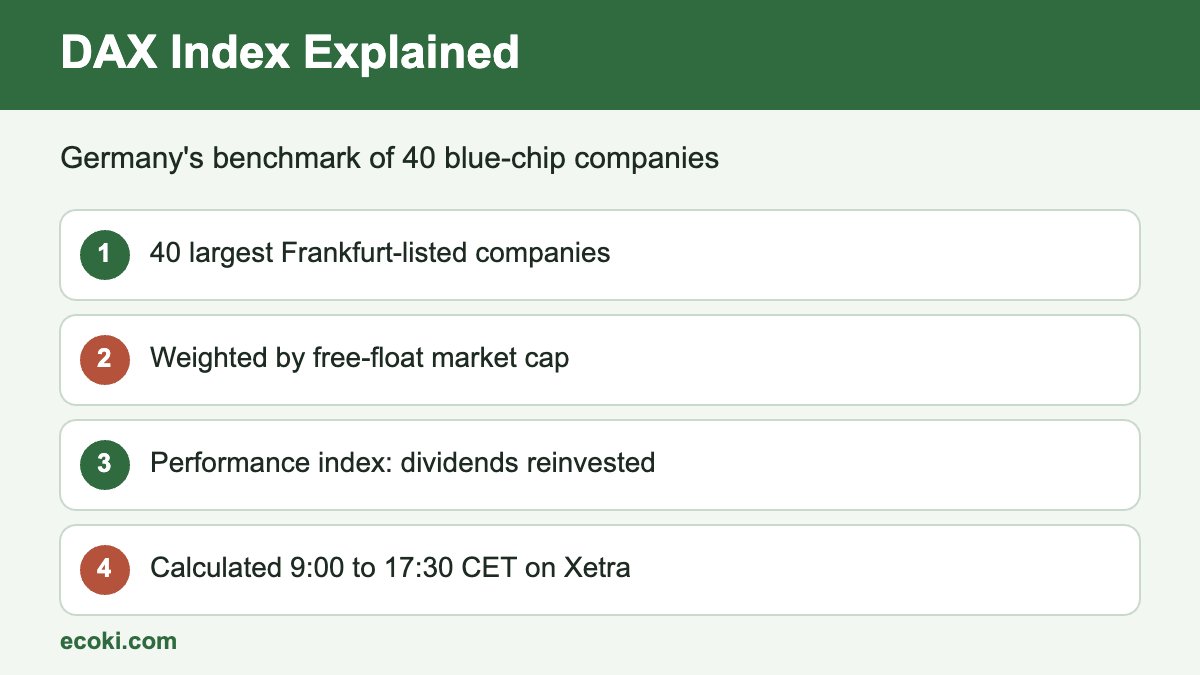
DAX Index Key Facts
| Full name | Deutscher Aktienindex (German Stock Index), often called “DAX 40” |
|---|---|
| Number of companies | 40 (30 until September 2021) |
| First published | 1 July 1988 |
| Base value | 1,000 points (as of 30 December 1987) |
| Index type | Performance index (dividends reinvested); a price-index version also exists |
| Weighting | Free-float market capitalisation, with a cap on individual weights |
| Exchange / trading venue | Frankfurt Stock Exchange, Xetra electronic trading |
| Index provider | Deutsche Börse group (STOXX / Qontigo) |
| Currency | Euro |
| Xetra trading hours | 9:00 to 17:30 CET |
What Does the DAX Measure?
The DAX measures the combined value of Germany’s biggest listed companies, adjusted for how many shares are freely available to trade. When the share prices of these companies rise overall, the DAX rises. When they fall, it falls.
Because the 40 members include global exporters, banks, insurers, carmakers, chemical companies and tech firms, the DAX is often used as a barometer for both the German economy and European industry more broadly. Deutsche Börse itself describes the index as a “benchmark and barometer” for Germany (Deutsche Börse).
Keep in mind that many DAX companies earn most of their revenue outside Germany. A weak German economy doesn’t always mean a weak DAX, and vice versa.
A Short History of the DAX
- 1987: The base value of 1,000 points is set as of 30 December 1987.
- 1 July 1988: The DAX is first published, founded by the Börsen-Zeitung newspaper, the Frankfurt Stock Exchange and the Association of German Stock Exchanges.
- 1990s: German reunification and the arrival of electronic trading broaden the market. Xetra later becomes the main trading venue.
- 2000–2003: The dot-com crash hits the index hard.
- 2008–2009: The global financial crisis brings another deep fall.
- 2020: The Wirecard accounting scandal, involving a DAX member, triggers calls for stricter membership rules.
- September 2021: The DAX expands from 30 to 40 companies, with new quality criteria including profitability, timely financial reports and an audit committee (Deutsche Börse glossary).
How the DAX Is Calculated
The DAX is a free-float market-capitalisation-weighted index. In simple terms:
- For each company, multiply the share price by the number of shares freely available to the public (excluding large strategic holdings).
- Add up these values for all 40 companies.
- Divide by a divisor that keeps the index continuous when members change or corporate actions happen.
- Apply a weight cap so that no single company dominates.
Bigger companies therefore move the index more. A 2% move in SAP, one of the largest members, has far more impact than a 2% move in a smaller member.
Performance index vs price index
| DAX (performance index) | DAX price index | |
|---|---|---|
| Dividends | Assumed reinvested | Ignored |
| Headline figure | Yes, this is the “DAX” usually quoted | Less commonly quoted |
| Long-term growth | Higher, because dividends compound | Lower |
| Comparable with | Total-return versions of other indices | S&P 500, FTSE 100, Dow headline figures |
When comparing the DAX with the Dow Jones or FTSE 100, use the same type of index on both sides, or the comparison will be misleading.
How Companies Enter and Leave the DAX
Membership is reviewed regularly. To be eligible, a company generally needs:
- A listing in the Prime Standard segment of the Frankfurt Stock Exchange.
- A registered office or operating headquarters in Germany.
- Sufficient free-float market capitalisation and trading liquidity.
- Compliance with quality rules introduced in 2021, such as timely audited reports and an audit committee.
Companies are ranked by free-float market capitalisation. Clear leaders can enter at a review and clear laggards can be removed. Fast entry or exit can also happen if a company’s size changes dramatically. Exact thresholds and rules are set out in the index provider’s official guide and are updated from time to time.
DAX Companies by Sector
The exact list changes over time, but the DAX typically includes companies from these sectors:
| Sector | Examples of DAX members |
|---|---|
| Technology and software | SAP, Infineon |
| Industrials and engineering | Siemens, Airbus, Rheinmetall, MTU Aero Engines |
| Financials and insurance | Allianz, Munich Re, Deutsche Bank, Commerzbank, Deutsche Börse |
| Automotive | Mercedes-Benz Group, BMW, Volkswagen, Porsche AG |
| Chemicals and healthcare | BASF, Bayer, Merck KGaA, Siemens Healthineers |
| Telecoms | Deutsche Telekom |
| Utilities and energy | E.ON, RWE |
| Consumer and retail | adidas, Beiersdorf, Zalando (membership has varied) |
| Real estate and logistics | Vonovia, DHL Group |
Always check the current constituent list on the index provider’s website, because membership changes at regular reviews.
The DAX and the Energy Transition
Germany’s shift away from nuclear and coal and toward renewables, known as the Energiewende, shows up clearly in the DAX. Utilities such as RWE and E.ON have reshaped their businesses around wind, solar and grids, while chemical companies like BASF are heavily exposed to natural gas prices. When European gas prices spiked in 2022, energy-intensive members came under pressure. If you’re curious why gas isn’t counted as a renewable fuel, see our explainer is natural gas renewable.
For sustainability-minded investors, Deutsche Börse’s index family also includes ESG-screened versions of German indices. They exclude or down-weight companies based on environmental, social and governance criteria.
DAX vs Other Major Stock Indices
| Index | Country | Members | Weighting | Headline type |
|---|---|---|---|---|
| DAX | Germany | 40 | Free-float market cap | Performance (total return) |
| FTSE 100 | UK | 100 | Free-float market cap | Price |
| CAC 40 | France | 40 | Free-float market cap | Price |
| Euro Stoxx 50 | Eurozone | 50 | Free-float market cap | Price |
| S&P 500 | USA | About 500 | Float-adjusted market cap | Price |
| Dow Jones Industrial Average | USA | 30 | Price-weighted | Price |
| Nikkei 225 | Japan | 225 | Price-weighted | Price |
Other German Indices: MDAX, SDAX and TecDAX
- MDAX: the next 50 companies by size after the DAX (mid caps).
- SDAX: 70 smaller companies ranked below the MDAX (small caps).
- TecDAX: the 30 largest technology companies across the DAX, MDAX and SDAX.
- HDAX: combines DAX, MDAX and TecDAX members.
Together, these let investors target large, mid or small German companies, or German tech specifically.
How to Invest in the DAX
You can’t buy an index directly, but you can get exposure in several ways:
| Method | How it works | Best for | Risks |
|---|---|---|---|
| DAX ETF | A fund that holds DAX shares or replicates its return | Long-term investors | Market risk; small annual fees |
| Index mutual fund | Similar to an ETF, bought through a fund platform | Regular savings plans | Fees can be higher than ETFs |
| Individual DAX shares | Buy selected companies directly | Investors who research companies | Less diversification |
| Futures and options | Exchange-traded derivatives on the DAX | Professional traders and hedgers | Leverage magnifies losses |
| CFDs and certificates | Leveraged products offered by brokers and banks | Short-term speculation | High risk; many retail traders lose money |
Things to check before buying a DAX ETF
- Ongoing charge (TER): lower is better for a plain index fund.
- Replication method: physical (holds the shares) or synthetic (uses swaps).
- Dividend policy: accumulating funds reinvest dividends; distributing funds pay them out.
- Currency risk: if your home currency isn’t the euro, exchange-rate moves affect your returns.
- Tax treatment in your country of residence.
What Moves the DAX?
- Global growth and trade: many members are big exporters, so demand from China and the U.S. matters.
- European Central Bank policy: interest-rate decisions affect banks, insurers and company valuations.
- Energy prices: chemical and industrial firms are sensitive to gas and power costs.
- The euro: a weaker euro can boost exporters’ earnings when converted back.
- Big-company results: earnings from the largest members can move the whole index.
- Geopolitics: conflicts and trade disputes affect investor sentiment.
DAX Trading Hours
The official DAX is calculated during Xetra trading, from 9:00 to 17:30 Central European Time on trading days. Deutsche Börse also publishes indicative values outside those hours, and DAX futures trade for longer. Prices quoted by brokers before 9:00 or after 17:30 are often based on futures or indications, not the official index.
Why Reinvested Dividends Make Such a Difference: A Worked Example
Here’s a simplified, hypothetical illustration of why a performance index pulls ahead of a price index over time.
Imagine a basket of shares worth 1,000 points whose prices grow 4% a year and which pays a 3% dividend yield every year.
| Year | Price index (prices only) | Performance index (dividends reinvested) |
|---|---|---|
| 0 | 1,000 | 1,000 |
| 10 | ≈ 1,480 | ≈ 1,967 |
| 20 | ≈ 2,191 | ≈ 3,870 |
| 30 | ≈ 3,243 | ≈ 7,612 |
After 30 years, the performance index is more than twice the price index, purely because dividends were reinvested at 7% total growth versus 4%. These figures are illustrative only, not DAX history, but they show why you must compare like with like.
How to Buy a DAX ETF: Step by Step
- Open an account with a regulated broker that offers European ETFs.
- Search by name or ISIN for “DAX” ETFs and shortlist two or three.
- Compare ongoing charges, fund size, replication method and dividend policy.
- Check the trading venue and currency so you’re not paying unnecessary currency conversion fees.
- Decide on a lump sum or monthly savings plan. Regular investing spreads your entry points over time.
- Place a limit order during main trading hours, when spreads are usually tighter.
- Review once or twice a year rather than reacting to daily moves.
Risks of Investing in the DAX
- Sector concentration: industrials, financials and carmakers make up a large share.
- Company concentration: a handful of the biggest members drive much of the index’s movement.
- Export dependence: trade disputes or slower global demand hit many members at once.
- Energy sensitivity: chemical and manufacturing firms are exposed to gas and power prices.
- Currency risk for investors outside the eurozone.
- Market risk: like any stock index, the DAX can fall sharply, as it did in 2000–2003 and 2008.
Diversifying across regions, for example by combining European, U.S. and global funds, reduces dependence on any single market.
How to Read a DAX Chart
- Use a log scale for long periods. On a normal scale, recent moves look huge simply because the index level is higher.
- Check which version you’re looking at. Most charts show the performance index; some platforms label the price index separately.
- Look at volume and breadth, not just the level. A rise driven by one or two giant members is weaker than a broad rally.
- Compare with the MDAX to see whether mid-sized German firms are moving the same way.
DAX Glossary
| Term | Meaning |
|---|---|
| Xetra | Deutsche Börse’s electronic trading platform used for DAX calculation |
| Prime Standard | The Frankfurt market segment with the highest transparency requirements |
| Free float | Shares available for public trading, excluding large strategic stakes |
| Fast entry / fast exit | Rules allowing quick index changes outside regular reviews |
| FDAX | The DAX futures contract traded on Eurex |
| ISIN | International Securities Identification Number used to find funds and shares |
| TER | Total expense ratio, the annual cost of a fund |
Common Misunderstandings About the DAX
- “The DAX tracks the German economy.” Only partly. Many members earn most of their revenue abroad.
- “A record DAX means German shares are at record prices.” Not exactly. Because it’s a performance index, reinvested dividends push it higher over time.
- “DAX 40 is a different index from the DAX.” It’s the same index; “DAX 40” just highlights the post-2021 member count.
- “The DAX is the whole German market.” It covers the 40 biggest names. MDAX and SDAX cover many more companies.
Lessons From the Wirecard Scandal
Wirecard, a payments company, was a DAX member when it admitted in June 2020 that around €1.9 billion of cash on its balance sheet probably didn’t exist, and it soon filed for insolvency. The episode exposed weaknesses in auditing and supervision, and it directly shaped the 2021 reforms that added quality criteria for DAX membership.
For investors, the lesson is simple: an index membership is not a seal of approval. Index rules focus mainly on size and liquidity. Diversification protects you from any single company failing, which is one of the strongest arguments for index funds over a handful of individual shares.
Who Uses the DAX?
- Fund managers measure German equity funds against it.
- ETF providers build funds that replicate it.
- Traders use DAX futures and options to speculate or hedge.
- Economists and journalists watch it as a quick read on German corporate health.
- Companies value membership for visibility and the steady demand from index funds.
For the US side of the picture, read our guide to INDEXSP: .INX, the S&P 500 ticker. If you need a broker to buy index funds, our Charles Schwab review breaks down the costs.
Frequently Asked Questions
How many companies are in the DAX?
The DAX has 40 companies. It started with 30 members in 1988 and expanded to 40 in September 2021, when Deutsche Börse also introduced stricter quality criteria for membership. Membership is reviewed regularly, so individual companies can enter or leave the index.
Why is the DAX a performance index?
The DAX was designed to show the total return an investor would get, including dividends reinvested. That’s different from most headline indices, which only track prices. It means the DAX’s long-term growth isn’t directly comparable to price indices such as the S&P 500 or FTSE 100.
What does DAX stand for?
DAX stands for Deutscher Aktienindex, which means German Stock Index. It is calculated by the Deutsche Börse group and based on trading on the Frankfurt Stock Exchange’s Xetra platform. It is Germany’s best-known stock market benchmark.
Can I invest in the DAX from outside Germany?
Yes. Many brokers in Europe, the UK and the U.S. offer DAX-tracking ETFs or access to individual German shares. Check fees, the fund’s currency and how your country taxes foreign dividends and gains. Non-euro investors also take on currency risk.
Is the DAX a good investment?
The DAX offers diversified exposure to Germany’s largest companies, but it is concentrated in industrials, financials and autos, and it can be volatile. Whether it suits you depends on your goals, time horizon and other holdings. Consider a licensed adviser for personal advice.
What is the difference between the DAX and the MDAX?
The DAX covers Germany’s 40 largest listed companies, while the MDAX covers the next 50 by size. MDAX members are mid-sized firms that are often more domestically focused and can grow faster, but they also tend to be more volatile. Many investors hold both for broader German exposure.
When does the DAX open and close?
The official DAX is calculated during Xetra trading hours, from 9:00 to 17:30 Central European Time on trading days. Brokers may quote DAX prices outside those hours, but those are usually based on futures or indicative values rather than the official index level.
The Bottom Line
The DAX is the go-to benchmark for German blue-chip stocks: 40 large companies, weighted by free-float market value, with dividends reinvested in the headline figure. Understand that last point before comparing it with other indices, check the current member list before investing, and remember that an index tracker gives you the whole basket, including its heavy tilt toward industry, finance and autos.
Many readers look up DAX market news on finance news aggregators. If you use one of them, read our FintechZoom review first to see whether FintechZoom is legit, how the .io and .com sites differ and how far you can trust their numbers.